
BREAKING UPDATE — NOVEMBER 10, 2026
Gamehaus Holdings (NASDAQ: GMHS): Anamana Opens AI Entertainment Studio to the Public, With Subscriptions Starting at $29 a Month
Just one day after a major SEC ownership disclosure, another development is adding momentum to the Gamehaus Holdings story.
This time, it’s not about who owns the company.
It’s about what the company Gamehaus plans to acquire is now offering customers.
On November 10, Gamehaus Holdings (NASDAQ: GMHS) announced that Anamana has officially opened Anamana Studio for public commercial use, marking its transition from an invitation-only creator program to a globally available, subscription-based service.
And for investors watching Gamehaus’s proposed $26.6 million expansion into AI-native entertainment, that distinction matters.
The company isn’t simply talking about a new entertainment strategy. Anamana is now offering its production technology to paying customers.
From Private Testing to a Commercial Launch
Anamana Studio is designed to help creators produce short-form, episodic video entertainment using AI-assisted production technology.
Instead of relying on conventional filming, large production crews, and lengthy postproduction processes, the software brings script processing, visual asset creation, and scene development together in one production environment.
The newly announced pricing establishes two entry points:
- $29 per month for individual creators.
- $499 per month for creator teams.
Previously, access was limited to selected participants in the Anamana 100 incubator.
Now, creators around the world can subscribe commercially.
That creates a potential new recurring-revenue opportunity alongside Anamana’s existing content production and distribution activities.
There’s Already Content Coming Out of the Studio
Anamana says creators participating in its closed beta have produced micro-serial titles that subsequently reached commercial distribution through the Anamana streaming app.
The production software has also been shaped by different international storytelling markets.
Chinese production practices influenced the development of fast-paced episodic storytelling. English-language workflows helped establish accessibility for global creators. Japanese production needs led to specialized features, including support for vertical right-to-left scripts and Japanese speech generation.
Anamana is now evaluating potential expansion into South Korea and Thailand.
There’s another important commercial distinction: independent subscribers retain ownership of their underlying intellectual property and exported content, allowing them to monetize their productions through channels of their choice.
That could help broaden Anamana’s potential audience beyond creators seeking financing or distribution through its incubator.
Why This Changes the GMHS Story
Consider the sequence of announcements.
November 2: Gamehaus announces its proposed $26.6 million transaction to acquire a majority interest in Techforge, Anamana’s parent company.
November 9: An SEC filing discloses Chairman Feng Xie’s 31.5% beneficial ownership position, adding visibility into the ownership structure surrounding the transaction.
November 10: Anamana launches its production software commercially, with published monthly subscription pricing.
In just over a week, investors have received new information about the acquisition, corporate control, and the commercial availability of the technology at the center of Gamehaus’s planned expansion.
The launch does not establish commercial success. Anamana has not disclosed subscriber numbers, subscription revenue, or profitability from the new offering. The proposed acquisition also remains subject to closing conditions.
But it does mark a tangible operational milestone.
The question is no longer just whether Gamehaus can enter AI-native entertainment. It’s whether Anamana can turn its newly available production technology into a growing commercial business.
For investors following NASDAQ: GMHS, that’s an important development to watch.
Source: Gamehaus Holdings — November 10, 2026 announcement via PR Newswire
11/09/26 – BREAKING UPDATE: A new SEC filing reveals Chairman Feng Xie’s 31.5% beneficial ownership stake and expected 87.6% voting control as Gamehaus prepares for a major transformation.
Sponsored Investor Awareness
A week ago, the Gamehaus Holdings (NASDAQ: GMHS) story was about a mobile gaming company making an ambitious move into artificial intelligence and digital entertainment.
Now, a new SEC filing has put an even bigger spotlight on the man behind that strategy.
On November 9, Gamehaus founder and chairman Feng Xie disclosed beneficial ownership of approximately 31.5% of the company, following transaction arrangements connected to its recently announced acquisition of Techforge.
But buried in the ownership details is another striking number. 87.6%.
That’s the percentage of Gamehaus’s aggregate voting power Xie is expected to control following the transaction, according to the company’s November 4 SEC filing.
Two numbers. One major acquisition. And a company preparing to reinvent what it does.
For investors following the intersection of AI, entertainment, and emerging Nasdaq companies, this is a story worth understanding.
The New SEC Filing: 31.5% Ownership, 87.6% Voting Power
The November 9 Schedule 13D reports that Xie beneficially owns approximately 26.6 million Gamehaus shares, including shares held through affiliated entities and shares issuable upon conversion of Class B stock.
The disclosure is tied to the company’s proposed Techforge acquisition, which involves issuing millions of new Class A shares.
Importantly, this isn’t a disclosure that Xie went into the public market and bought nearly one-third of Gamehaus overnight.
The ownership position reflects existing holdings and acquisition-related share arrangements.
But here’s what makes the filing significant.
Following completion of the transaction, Gamehaus expects Xie to hold approximately 31.5% of its outstanding ordinary shares while controlling roughly 87.6% of its voting power.
That gives the chairman considerable influence over the company’s direction.
And right now, Gamehaus is pursuing one of the biggest strategic shifts in its history.
The $26.6 Million Deal That Started It All
In our November 5 report on Gamehaus’s AI entertainment strategy, we examined the company’s agreement to acquire a majority stake in Techforge, parent of the AI-native entertainment business Anamana.
Now the ownership filing adds another layer to that transaction.
The proposed deal involves $26.6 million in total consideration and investment:
- $19.6 million in newly issued Gamehaus shares to acquire existing Techforge shares.
- $7 million in cash invested directly into Techforge.
- 24.5 million new Class A shares, valued at $0.80 per share, forming the stock consideration.
Upon completion, Gamehaus expects to own approximately 56% of Techforge.
The acquisition is subject to customary closing conditions and is expected to close in November.
This isn’t simply a purchase of another gaming studio.
Gamehaus is attempting something more ambitious: taking the capabilities it developed in mobile gaming and applying them to an emerging form of AI-assisted entertainment.
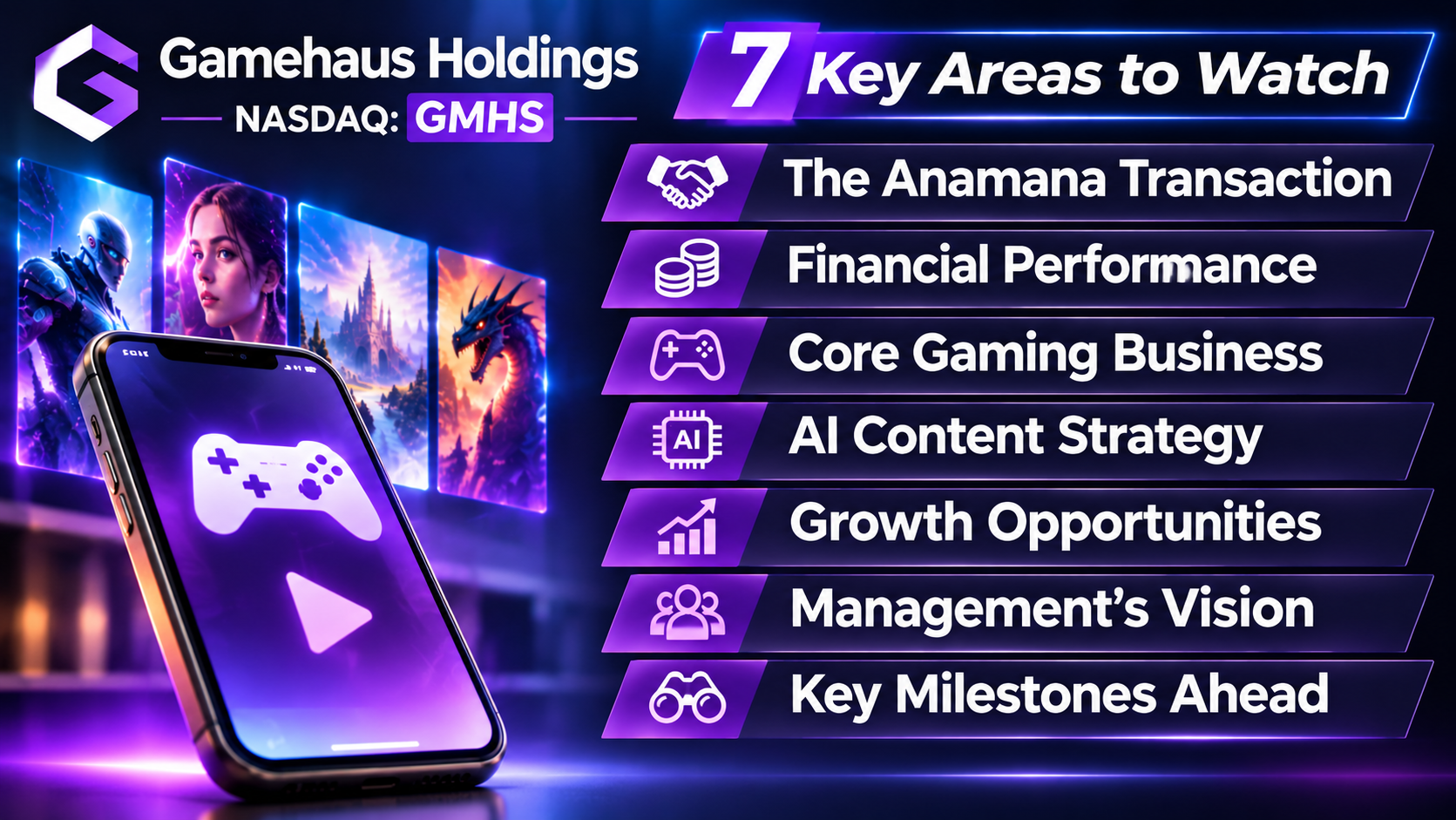
Gamehaus Holdings
Why Anamana Could Change the Gamehaus Story
Imagine producing short, serialized video entertainment without the production budgets, staffing, and timelines traditionally associated with live-action content.
That’s the opportunity Anamana is pursuing.
Its business combines AI-assisted content creation, short-form storytelling, and digital distribution.
The company envisions a system where creators can produce entertaining, mobile-first video series and distribute them through dedicated apps or established services such as YouTube and TikTok.
The production claims are particularly eye-catching.
Gamehaus says Anamana’s technology can reduce certain production resource requirements by as much as 97% compared with traditional live-action microdrama production.
That’s a company-reported estimate, not a demonstrated reduction in overall commercial costs or proof of profitability.
Still, the strategic possibilities are easy to see.
Gamehaus already works in a business built around understanding digital audiences: attracting users, measuring engagement, distributing content, and generating revenue from entertainment.
Anamana introduces a new kind of content for that expertise.
The central question is whether Gamehaus can turn its mobile publishing experience into a competitive advantage in AI-assisted video entertainment.
If management executes successfully, the company’s business could eventually look very different from the mobile game publisher investors know today.
There’s Already a Business Behind the Ambition
One of the more interesting aspects of Gamehaus is that this strategy isn’t beginning with a company that has no operating history.
For its fiscal year ended June 30, 2026, Gamehaus reported:
$104.7 million in revenue.
$3.9 million in net income.
$17.6 million in cash and cash equivalents.
Those are meaningful operating figures for a company pursuing a new direction.
Revenue declined 11.4% year over year, however, highlighting why the performance of its existing business remains important.
Management has indicated that it intends to maintain the mobile gaming operation with an emphasis on cash flow and profitability while developing Anamana as a potential future growth engine.
The company is effectively trying to build its next business alongside its existing one.
That creates opportunity, but it also raises the stakes for execution.
The Real Story: What Happens Next?
The November 9 SEC filing doesn’t guarantee that Gamehaus will succeed in AI entertainment.
It does something different.
It clarifies the ownership and voting structure behind a major strategic transition.
Xie has a substantial beneficial ownership position. The proposed acquisition involves a significant issuance of new shares. And the company is preparing to enter a new entertainment category with an ambitious production model.
There are risks investors shouldn’t ignore.
The new shares create dilution. The transaction involves related parties, including interests connected to Xie. Concentrated voting control limits the influence of minority shareholders. And Anamana must still prove its economics and commercial potential at scale.
But the developments also create clear milestones to watch.
Will the acquisition close as planned?
Can Gamehaus successfully integrate Anamana?
Will AI-assisted content production translate into measurable revenue?
And can the company build a profitable second business while maintaining its gaming operation?
Those are the questions that will shape the next chapter.
A New Chapter for NASDAQ: GMHS
Just days ago, the headline was Gamehaus’s proposed expansion from mobile gaming into AI entertainment.
Now, the story includes a $26.6 million transaction, a 31.5% beneficial ownership disclosure, and anticipated 87.6% voting control for its chairman.
The company has outlined a bold direction. The SEC filings have revealed more about the structure behind it.
The next test is execution.
For investors tracking emerging companies at the crossroads of artificial intelligence, digital content, and entertainment, Gamehaus Holdings (NASDAQ: GMHS) has a developing corporate story worth watching closely.
Official Sources
- SEC Schedule 13D — November 9, 2026
- Gamehaus Form 6-K — November 4, 2026
- Gamehaus Announces Proposed Anamana Acquisition — November 2, 2026
Paid Advertising Disclosure
PAID ADVERTORIAL | SPONSORED INVESTOR INFORMATION
Small Cap Exclusive is owned and operated by King Tide Media, LLC, a U.S.-based corporation, which has been compensated up to $125,000 by Awareness Consulting Network for profiling Gamehaus Holdings (NASDAQ: GMHS). The publisher reports owning zero shares of GMHS. Campaign commencement date: November 5, 2026.
This is paid promotional content, not independent investment research or investment advice. Compensation creates a financial conflict of interest. Gamehaus is subject to substantial business, governance, dilution, and investment risks. Nothing in this article constitutes a recommendation to buy, sell, or hold securities. Investors should review the company’s SEC filings and conduct independent due diligence.
Publisher: King Tide Media, LLC / Small Cap Exclusive, 806 E Windward Way, #616, Lantana, FL 33462.