
Gamehaus reports approximately 90% less developer labor for game prototypes, launches a new collection of mobile games, and reveals fresh audience-engagement figures from its expanding AI entertainment business.
Paid Advertorial
A little over two weeks ago, Gamehaus Holdings (NASDAQ: GMHS) was making headlines for a $26.6 million move into AI-native entertainment.
Now, something more interesting is happening.
The company is beginning to show what that strategy looks like in actual products.
In a rapid succession of announcements, Gamehaus has introduced 12 games developed through a new AI-assisted production process, disclosed substantial reductions in prototype-development labor, and highlighted more than 5 million minutes of viewing activity across three recent Anamana micro-serial productions.
And it’s all happening as Gamehaus works to expand beyond traditional mobile publishing.
The latest developments offer investors something more concrete to examine: live products, reported production efficiencies, audience engagement, and a growing collection of AI-created entertainment.
November 16: Gamehaus Reports a Dramatic Change in Game Development
The newest announcement comes from Gamehaus’s collaboration with Witmani, an AI game-development company in which Gamehaus made a minority investment earlier this year.
The two teams have developed an AI-assisted production process designed to make building mobile games faster and less labor-intensive.
The company’s reported results are striking.
Under its previous development process, creating a playable game prototype typically required three developers working approximately one to one-and-a-half weeks.
With the new process, Gamehaus estimates that a single developer can produce a comparable prototype in approximately one-and-a-half to two days.
That represents an estimated 87%–93% reduction in developer labor, based on Gamehaus’s internal measurements.
The distinction is important: this is a measure of prototype-development effort, not independently verified savings across the entire game-production process.
Still, it illustrates why management is pursuing this technology.
If fewer developer hours are required to test new concepts, Gamehaus could potentially experiment with more games while committing fewer resources to each initial prototype.
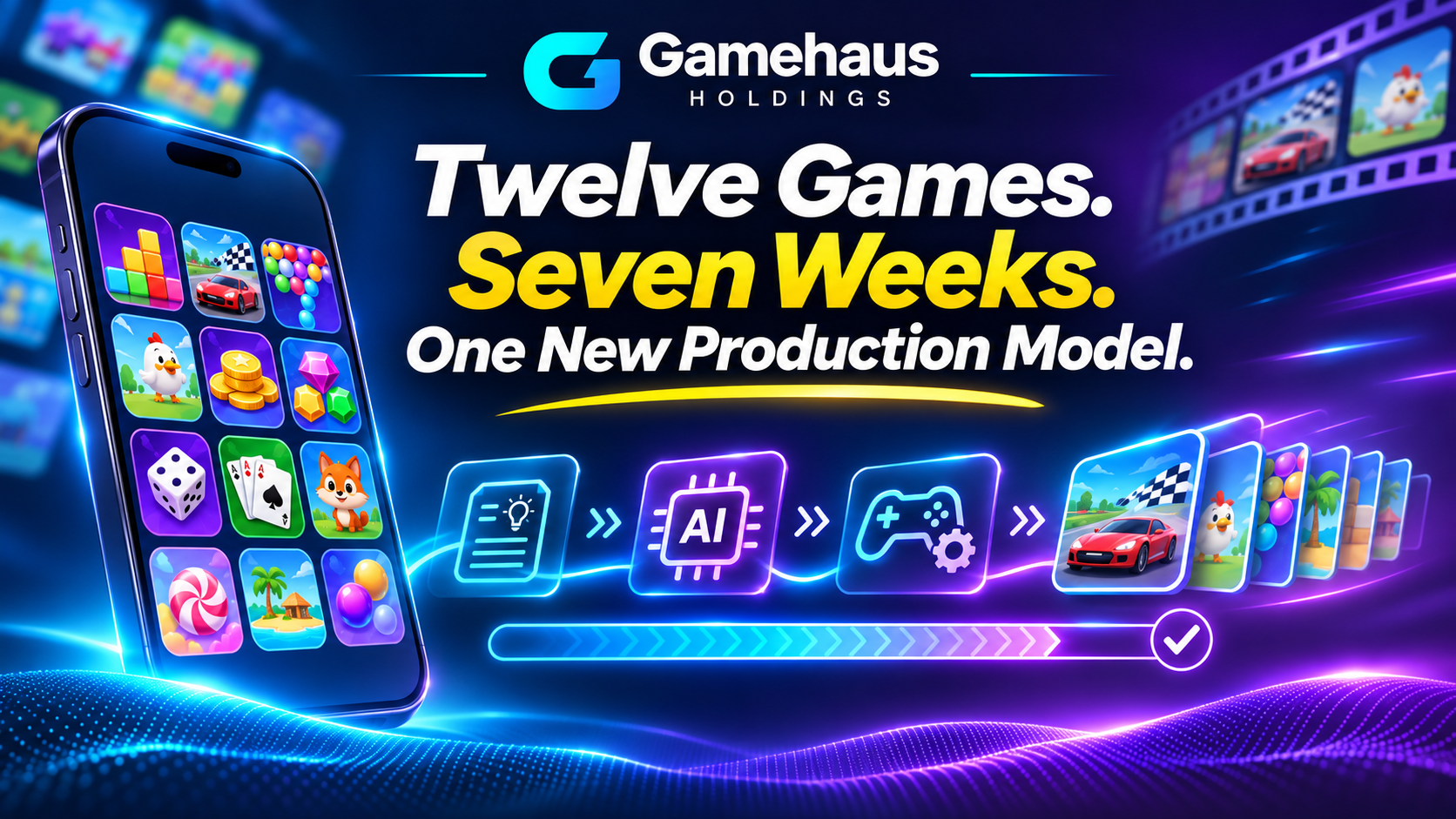
Twelve Games. Seven Weeks. One New Production Model.
Here’s where the development becomes more tangible.
Gamehaus announced that its first game collection built using the new process, Ease Games: Fun Anytime, is live on Google Play.
The collection brings together 12 casual games, including puzzles and arcade-style entertainment.
According to Gamehaus, the project moved from kickoff to 12 completed games in approximately seven weeks.
And management has considerably bigger plans.
An upcoming update is intended to expand the collection to 20 games, with a target of approximately 50 games within the next two quarters.
These are development goals, not guaranteed releases.
But the implications are worth examining.
For a company built around discovering, publishing, and monetizing mobile entertainment, the ability to produce and test new content more efficiently could become an important operating advantage.
The opportunity isn’t simply making games faster. It’s finding out whether making more games can lead to better commercial results.
That will require evidence of downloads, retention, monetization, and profitability—metrics that the announcement did not establish.
Meanwhile, Anamana Reports 5 Million Minutes of Viewing Activity
The game-development announcement is only one side of the story.
On November 12, Anamana—the AI-native micro-serial entertainment business at the center of Gamehaus’s Techforge investment—reported encouraging audience-engagement figures.
Three recent productions accumulated more than 5 million combined viewing minutes as of November 9, according to Anamana’s internal data.
The titles include:
- The Duke’s Substitute Groom
- After Faking Alpha on an Idol Show
- Running with the Lycan King’s Secret Heir
The company reported that these titles reached leading positions within its own app for viewership and in-app revenue.
There’s another notable figure.
Across the three productions, Anamana reported average creator-incurred AI compute expenses of less than $2,900 per completed 30-episode series.
That figure covers AI generation, alternate takes, and rendering. It does not represent every expense involved in creating, distributing, or marketing the content.
Nevertheless, the combination of relatively low reported compute costs and measurable audience engagement helps explain the business model Gamehaus is pursuing.
Produce digital entertainment with fewer production resources. Bring that content to mobile audiences. Test which stories attract attention—and which generate revenue.
The opportunity is compelling, although Anamana has not provided the complete revenue and expense figures necessary to assess profitability.
Two AI Businesses. One Larger Strategy.
This is what makes the Gamehaus story more interesting than it was when we first covered the acquisition.
The company is pursuing AI in two connected areas.
In gaming, Gamehaus wants to reduce the effort required to create, test, and publish new entertainment.
In micro-serial video, Anamana wants to make episodic storytelling more accessible while building an audience and monetization business around the content.
The potential connection is significant.
Both businesses depend on creating engaging digital experiences, attracting audiences, measuring behavior, and converting engagement into revenue.
Gamehaus already has an established mobile publishing operation. Its fiscal 2026 revenue was approximately $104.7 million.
Anamana, by contrast, is an early-stage business. Techforge, its parent, reported approximately $109,000 in revenue and a $1.4 million net loss for the year ended June 30, 2026, with going-concern uncertainty disclosed in its audited financial statements.
The opportunity is real enough to investigate. So are the financial risks.
New SEC Filings: What Investors Also Need to Know
Alongside these operational developments, Gamehaus has made two important securities-related disclosures.
First, the company entered into an agreement permitting up to approximately $11.64 million in at-the-market sales of Class A shares.
That authorization does not establish that the full amount has been sold. Any issuance would provide potential financing but could also dilute existing shareholders.
Second, Gamehaus scheduled an extraordinary shareholder meeting for November 27, 2026, seeking approval for a proposed 1-for-10 share consolidation and authority for additional consolidations under specified conditions.
Those proposals had not been approved as of this update. A reverse share split changes the number of shares outstanding and the corresponding per-share price mechanically; it does not, by itself, create business value.
Investors should consider these capital-market developments alongside the company’s operating announcements.
The Next Chapter for GMHS
In the span of a few weeks, Gamehaus has announced a substantial strategic acquisition, completed the $19.6 million share-purchase portion of the Techforge transaction, opened Anamana Studio to public subscriptions, and introduced an AI-assisted collection of mobile games.
It has also reported new viewing and production metrics that offer an early look at how its entertainment strategy might operate.
The narrative has moved beyond the acquisition announcement. Now comes the harder part: proving the economics.
Can Gamehaus scale its new game-production process?
Can Anamana convert viewing activity into sustainable revenue?
And can the company execute its ambitions while managing dilution, financing needs, and integration risks?
Those are the questions that will shape what comes next.
For investors following the intersection of artificial intelligence, gaming, and digital entertainment, Gamehaus Holdings (NASDAQ: GMHS) has a developing business story with several measurable milestones ahead.
Sources for This Update
- Gamehaus — November 16, 2026: AI Game Production and Ease Games Launch
- Anamana — November 12, 2026: Creator Ecosystem and Audience Engagement
- SEC Form 6-K — At-the-Market Offering Agreement
- SEC Proxy Statement — November 27 Shareholder Meeting
- SEC Form 6-K — Techforge Acquisition and Audited Financial Statements
PAID ADVERTORIAL — SPONSORED INVESTOR INFORMATION. This article is compensated promotional content. Small Cap Exclusive / King Tide Media, LLC has disclosed compensation of up to $125,000 from Awareness Consulting Network for profiling Gamehaus Holdings. The publisher reports owning zero GMHS shares. This is not independent investment research or investment advice. Securities investing carries substantial risk, including possible loss of principal. See the complete paid-promotion disclosure in the original article.