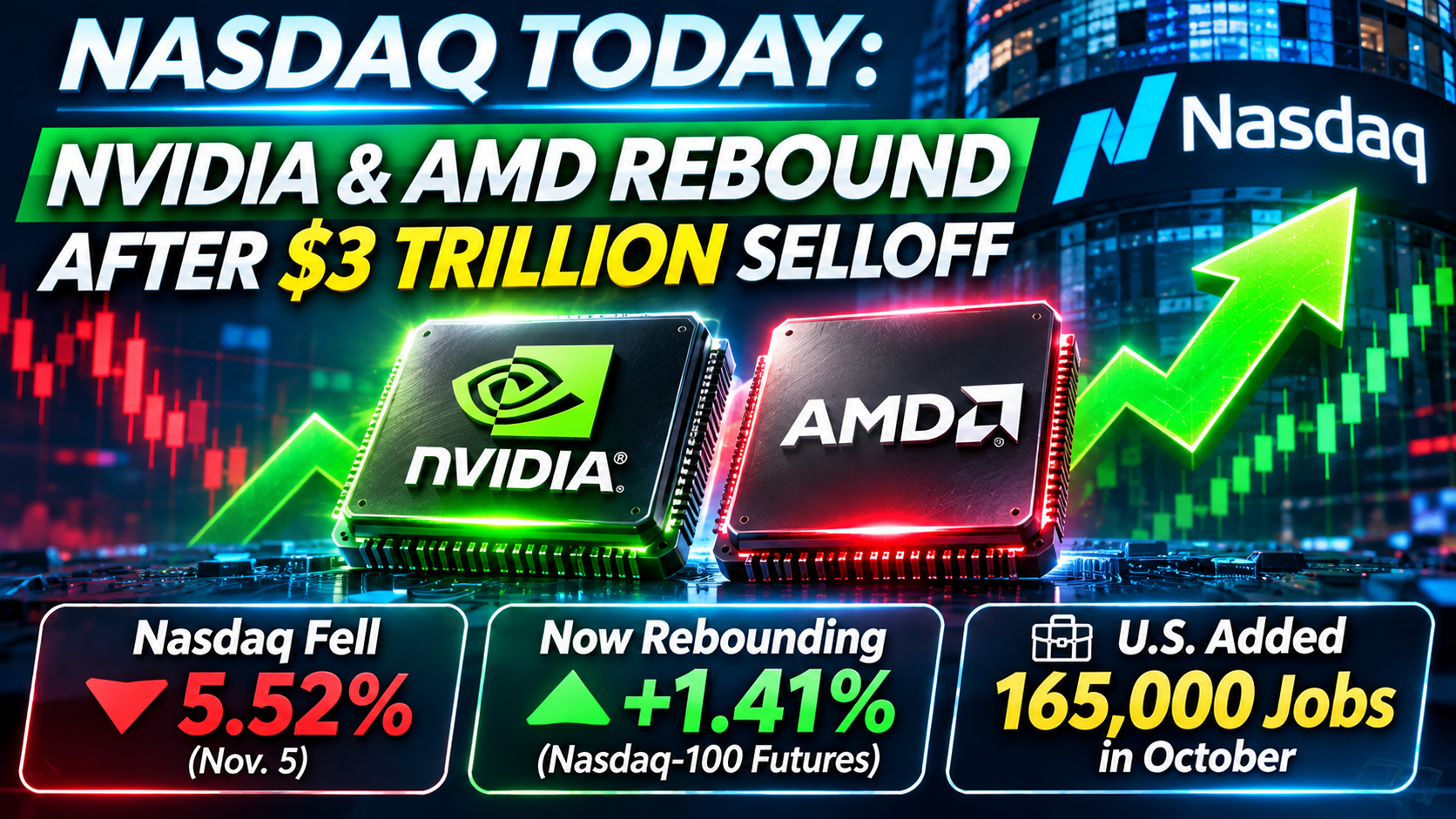
The Nasdaq today is attempting a sharp rebound after Thursday’s historic technology selloff erased nearly $3 trillion in S&P 500 market capitalization.
On November 5, the Nasdaq Composite plunged 5.52%, its largest single-day decline in 19 months, while the S&P 500 fell 4.36% and the Dow Jones Industrial Average dropped 3.44%.
Now, technology stocks are showing signs of recovery.
Nvidia (NASDAQ: NVDA), Advanced Micro Devices (NASDAQ: AMD), Micron Technology (NASDAQ: MU), and several other semiconductor companies rallied in Friday’s early premarket trading.
Adding another major development, the U.S. economy generated 165,000 jobs in October, significantly exceeding economists’ expectations of approximately 65,000.
The combination creates an important question for Wall Street: Is Friday’s rebound the beginning of a recovery, or merely a temporary bounce following a severe selloff?
Nasdaq Today: Market Rebounds After Thursday’s Selloff
U.S. stock futures moved unevenly on Friday morning.
Technology shares led the recovery, while broader market sentiment remained sensitive to interest rates and economic conditions.
According to Reuters, the following figures were reported at approximately 6:24 a.m. Eastern Time:
| Market indicator | Premarket movement |
|---|---|
| Nasdaq-100 futures | +1.41% |
| S&P 500 futures | +0.29% |
| Dow Jones futures | -0.91% |
| Nvidia shares | Approximately +4.5% |
| Other major chip stocks | +4.6% to +8.2% |
These figures are time-stamped premarket observations, not current prices or closing returns.
The Nasdaq today is showing a particularly strong recovery among semiconductor companies that suffered significant declines Thursday.
However, the broader market’s mixed performance suggests investors have not entirely moved past their concerns.
Why Is the Nasdaq Up Today? Five Factors Behind the Recovery
1. Nvidia Rebounds After Its Worst Session in Months
Nvidia is one of the most influential companies in the artificial intelligence industry.
The company’s processors are central to many AI computing systems, making its share price an important indicator of investor sentiment toward the industry.
After falling more than 9% on Thursday, Nvidia recovered approximately 4.5% in Friday’s early premarket trading.
The recovery followed its steepest single-day decline since January 2025.
For investors watching the Nasdaq today, Nvidia’s performance is significant because major technology companies can influence the direction of broader indexes.
But an early rebound does not guarantee that the stock has established a lasting recovery.
2. AMD, Micron and Broadcom Lead the Semiconductor Bounce
Advanced Micro Devices, Micron, Broadcom, and Intel were also recovering Friday morning.
Several major semiconductor shares rose between approximately 4.6% and 8.2% in early trading.
The recovery followed unusually severe selling across the chip industry.
Semiconductor companies occupy different positions in the technology supply chain.
AMD develops high-performance processors and AI accelerators.
Micron produces memory used in computing applications.
Broadcom supplies semiconductor and networking technologies.
Their simultaneous rebound suggests investors are reassessing the sector after Thursday’s steep losses.
3. Strong October Jobs Report Changes the Economic Picture
The Bureau of Labor Statistics released its October employment report at 8:30 a.m. Eastern Time on November 6.
The results exceeded expectations.
| Employment indicator | October 2026 |
|---|---|
| Jobs added | 165,000 |
| Unemployment rate | 4.1% |
| Average hourly earnings growth | 0.4% month over month |
| Professional and business services jobs | +70,000 |
| Healthcare jobs | +42,000 |
The economy added substantially more jobs than economists had anticipated.
September employment was also revised upward to 60,000 from the initially reported 29,000.
These figures suggest that hiring strengthened during October.
However, the implications for stocks are complicated.
A stronger labor market can support economic growth and corporate earnings.
At the same time, stronger employment and wage growth may influence Federal Reserve decisions about interest rates.
That makes the employment report a central development for the Nasdaq today.
4. Investors Reassess AI Infrastructure Spending
Thursday’s technology selloff was driven partly by concerns about the enormous investments flowing into artificial intelligence infrastructure.
Building and operating advanced data centers requires significant capital, electricity, networking equipment, and computing hardware.
Investors are increasingly asking whether those expenditures can generate sufficient future financial returns.
The recent midterm elections have added uncertainty surrounding AI regulation and data-center development.
However, potential policy changes should not be confused with laws that have already been enacted.
Friday’s semiconductor rebound suggests some investors are reconsidering the severity of the previous session’s selling.
5. Technology Valuations Remain a Major Focus
Technology stocks can experience sharp price movements when investors change their expectations about future earnings.
AI-related businesses have attracted significant investment because of anticipated long-term growth.
But a promising industry does not guarantee that every company’s stock is attractively priced.
Investors must weigh revenue growth, profitability, cash flow, capital requirements, and valuations.
The Nasdaq today reflects this tension between optimism about AI adoption and uncertainty about the financial returns generated by large infrastructure investments.
What Caused the $3 Trillion Stock Market Selloff?
Thursday’s decline was one of the market’s most significant trading sessions in recent months.
The Nasdaq Composite entered correction territory, falling more than 10% from its recent record high.
Several developments contributed to the selling pressure.
AI Regulation Concerns
Following the November 3 midterm elections, investors reassessed the possibility of greater government oversight affecting AI development and data-center expansion.
Infrastructure Financing
Large technology investments can be sensitive to borrowing costs, power availability, and construction expenses.
High Market Expectations
Some AI stocks had valuations reflecting substantial future growth. Changes in expectations can therefore produce significant price declines.
Broad Technology Selling
When multiple large technology companies decline simultaneously, their combined index weight can contribute to substantial market-wide losses.
These concerns have not necessarily disappeared simply because some semiconductor stocks are rebounding.
Nasdaq Today: Which Stocks Are Investors Watching?
| Company | Ticker | Main area of interest |
|---|---|---|
| Nvidia | NVDA | AI chips and data-center demand |
| AMD | AMD | AI accelerators and server processors |
| Micron | MU | High-performance memory |
| Broadcom | AVGO | Semiconductor and networking infrastructure |
| Intel | INTC | Processor and manufacturing operations |
| CoreWeave | CRWV | AI cloud infrastructure |
| IREN | IREN | AI computing and data centers |
| Applied Digital | APLD | Data-center infrastructure |
These businesses face different operating conditions, financing requirements, and competitive pressures.
Their individual performance may diverge even when the semiconductor industry moves broadly higher or lower.
Is the Nasdaq in a Correction?
Yes.
Thursday’s 5.52% decline pushed the Nasdaq Composite more than 10% below its October record high.
A correction generally describes a decline of at least 10% from a recent peak.
Market corrections can happen during periods of economic growth and do not automatically indicate a recession.
However, they can reflect concerns about valuations, interest rates, corporate earnings, or broader financial conditions.
A rebound may recover part of a previous decline without ending the correction.
Investors watching the Nasdaq today should therefore evaluate whether the recovery broadens beyond a small group of semiconductor companies.
What Does the Nasdaq Recovery Mean for Small-Cap Stocks?
Smaller publicly traded companies can be especially sensitive to changes in investor confidence.
Many rely on borrowing or outside financing to support operations and expansion.
When markets experience sharp declines, access to capital may become more difficult or expensive.
However, the effect varies by business.
Companies with adequate cash reserves, established customers, and sustainable revenue may be better positioned than those requiring frequent financing.
Investors should examine balance sheets, operating cash flow, debt obligations, and revenue trends rather than assuming every small-cap stock will follow the Nasdaq.
For broader context, read our article on why small-cap stocks have been under pressure.
Will the Nasdaq Continue Rising?
The Nasdaq today has several competing influences.
The semiconductor rebound provides evidence of improving short-term sentiment toward certain technology companies.
The October employment report suggests the U.S. labor market performed better than expected.
However, the strong jobs numbers may also affect expectations for Federal Reserve interest-rate decisions.
Investors will continue monitoring corporate earnings, Treasury yields, inflation, and future AI infrastructure investment.
No single trading session can establish whether a market correction has ended.
Stay Ahead of Market-Moving News
From Nvidia and AMD to emerging technology and small-cap companies, SmallCapExclusive follows the financial developments shaping investor sentiment.
GET EXCLUSIVE STOCK MARKET UPDATES
Explore market news, earnings analysis, and emerging-company coverage.
Nasdaq Today: Frequently Asked Questions
Why is the Nasdaq up today?
Nasdaq-100 futures rebounded on November 6 as Nvidia, AMD, Micron, and other semiconductor shares recovered from Thursday’s technology selloff.
How much did the Nasdaq fall yesterday?
The Nasdaq Composite declined 5.52% on November 5, its largest single-day decline in approximately 19 months.
Why is Nvidia stock rising today?
Nvidia shares rose in early premarket trading after suffering a significant decline during Thursday’s broad AI-sector selloff.
How many jobs did the U.S. add in October 2026?
The Bureau of Labor Statistics reported 165,000 additional nonfarm payroll jobs, with unemployment at 4.1%.
Is the Nasdaq still in a correction?
Thursday’s closing level placed the Nasdaq Composite in correction territory. A premarket recovery in Nasdaq-100 futures does not by itself establish that the Nasdaq Composite has exited its correction.
Will AI stocks continue recovering?
Future performance remains uncertain and will depend on company earnings, valuations, financing conditions, government policy, and investor sentiment.
Bottom Line: Nasdaq Today
The Nasdaq today is attempting a significant rebound following Thursday’s $3 trillion market selloff.
Nvidia, AMD, Micron, and other semiconductor companies recovered in early trading, while the stronger-than-expected October employment report introduced an additional economic catalyst.
The U.S. economy added 165,000 jobs, offering evidence of stronger hiring but also raising questions about future interest-rate policy.
For investors, the important issue is whether improving market sentiment can develop into a sustained recovery.
A rebound after a steep selloff is meaningful—but it does not guarantee the correction is over.
Sources
- Reuters — Nasdaq Futures Rebound After AI Selloff, November 6
- Reuters — Nasdaq Posts Steepest Drop in 19 Months, November 5
- Bureau of Labor Statistics — October 2026 Employment Situation
- SmallCapExclusive — Palantir Earnings Analysis
Market figures reflect Friday morning trading observations, not the closing market. This article is independent editorial coverage and is not investment advice.
Editorial Disclosure — Non-Sponsored Content
This article is independent editorial content published by SmallCapExclusive, owned and operated by King Tide Media, LLC.
This article is not paid advertising. King Tide Media has not received compensation from any company or third party specifically for the publication or coverage of the securities discussed in this article.
The information is provided for informational and educational purposes only and does not constitute investment advice or a recommendation to buy, sell, or hold any security.
Market information is subject to change. Readers should conduct their own research before making investment decisions.