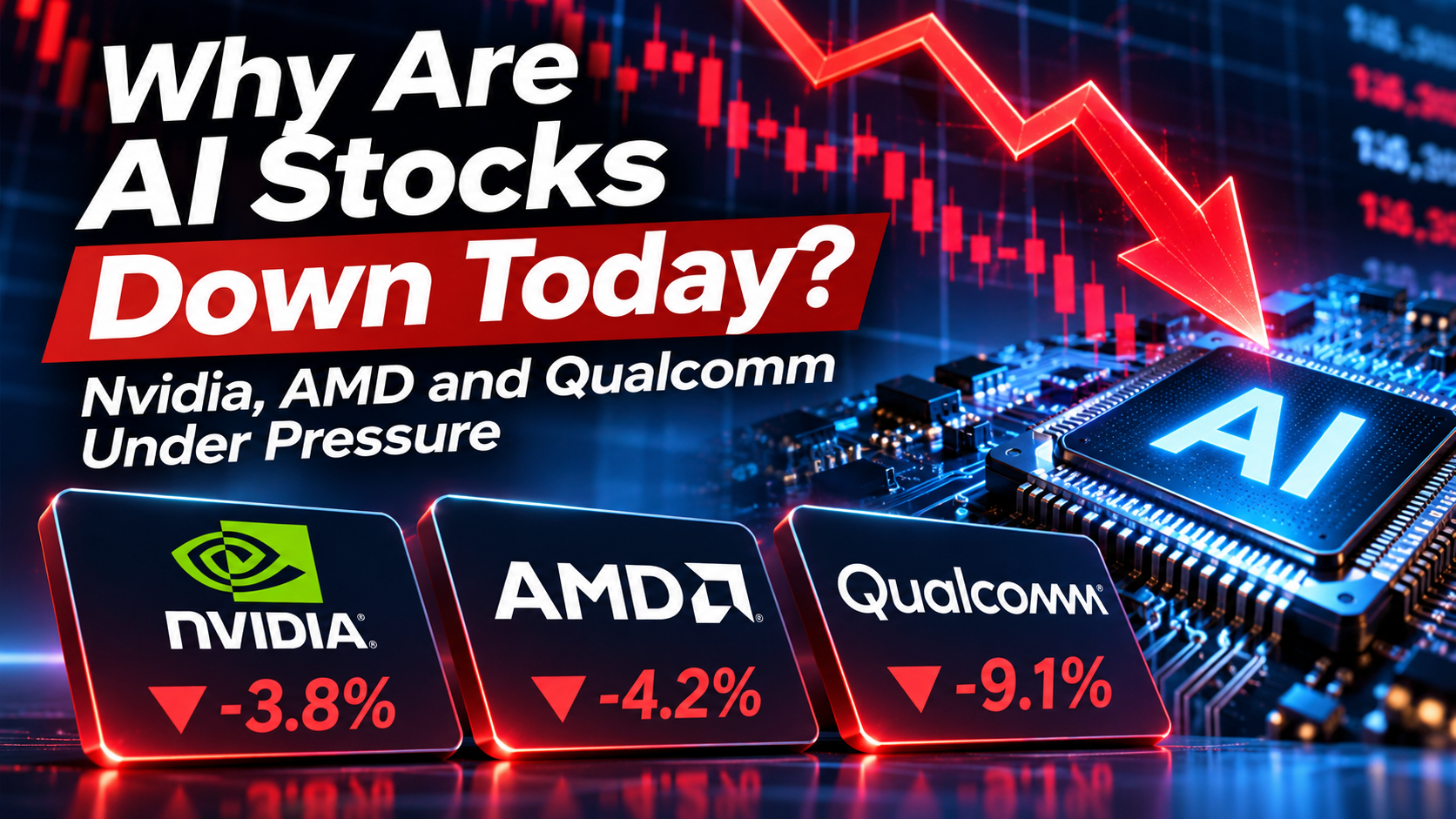
Why are AI stocks down today?
With AI stocks down across parts of the semiconductor and technology sectors, investors are reassessing artificial intelligence valuations, data-center spending, and the latest earnings results from Qualcomm (NASDAQ: QCOM).
The weakness follows a volatile week for Wall Street, including significant market reactions to the 2026 midterm elections.
Qualcomm’s fiscal fourth-quarter results have placed additional attention on semiconductor demand, while questions about the profitability of massive AI infrastructure investments continue to influence investor sentiment.
Nvidia (NASDAQ: NVDA), Advanced Micro Devices (NASDAQ: AMD), Qualcomm, and other technology companies are attracting attention as traders evaluate whether recent selling represents a temporary adjustment or a more significant change in market expectations.
Here’s what is driving the market discussion and what investors should monitor next.
AI Stocks Down Today: What’s Happening in the Market?
With AI stocks down during Thursday’s early trading, investors are examining the differences between strong long-term demand for artificial intelligence and the valuations assigned to companies participating in the industry.
Nasdaq-100 futures indicated weakness early Thursday while Dow Jones futures showed a comparatively stronger picture.
That divergence suggests some investors are rotating away from technology-related investments while maintaining exposure to other areas of the market.
The semiconductor sector has become a particular focus.
Qualcomm shares fell approximately 9% in premarket trading after the company reported disappointing handset revenue.
Although Qualcomm is not exclusively an AI semiconductor company, its results have contributed to broader scrutiny of technology demand.
Investors are also evaluating how spending on data centers, computing infrastructure, and AI applications may evolve over the coming quarters.
Why Are AI Stocks Down? Five Key Reasons
Several factors may explain why AI-related equities are experiencing pressure.
1. Qualcomm Earnings Raise Semiconductor Concerns
Qualcomm reported fiscal fourth-quarter 2026 revenue of approximately $10.32 billion, down 8% year over year.
Its handset-related revenue declined approximately 26% to $5.14 billion.
The company continues to invest in automotive technology, connected devices, and data-center opportunities.
However, weakness in its established smartphone-chip business has raised concerns about near-term revenue growth.
For investors, Qualcomm’s results highlight an important issue: expansion into new technology markets does not immediately eliminate exposure to traditional business cycles.
2. AI Data-Center Spending Faces Greater Scrutiny
Artificial intelligence infrastructure requires enormous investments in processors, networking equipment, electricity, cooling systems, and specialized facilities.
Major technology companies have committed substantial capital to expanding these capabilities.
However, investors are questioning whether those expenditures will generate sufficient long-term financial returns.
Some projects face delays or additional costs involving power availability, construction, financing, and regulatory approvals.
With AI stocks down, investors are increasingly distinguishing companies generating meaningful revenue from those relying primarily on expectations of future growth.
Continued AI adoption does not guarantee that every infrastructure investment will be profitable.
3. Technology Stock Valuations Remain Elevated
Many AI-related companies have experienced substantial share-price appreciation in recent years.
Their valuations often reflect expectations of rapid future revenue and earnings growth.
When those expectations are demanding, even strong financial results can lead to disappointing stock-market reactions.
Earlier this week, Palantir Technologies (NASDAQ: PLTR) reported substantial quarterly revenue growth but faced investor questions about new contract activity.
That illustrates how a company’s operating performance can improve while its share price declines.
AI stocks down today does not necessarily mean AI businesses are performing poorly. In some cases, investors may simply be reconsidering the prices they are willing to pay for future growth.
4. Interest Rates Affect AI Infrastructure Economics
Interest rates remain an important factor for technology and infrastructure investment.
Building advanced computing facilities requires substantial capital.
When financing costs are elevated, companies may face greater pressure to justify expansion plans.
Businesses with significant debt or frequent capital requirements may be especially sensitive.
For smaller companies, borrowing costs can influence product development, hiring, and the ability to finance growth.
Investors are therefore monitoring Treasury yields and Federal Reserve expectations alongside semiconductor earnings.
5. Political Uncertainty Adds to Market Volatility
The November 3 midterm elections introduced additional uncertainty surrounding future government policy.
Investors are evaluating the possible implications for artificial intelligence regulation, energy infrastructure, federal spending, and corporate taxation.
However, election results do not automatically translate into immediate policy changes.
Markets often respond to expectations before the actual details of proposed legislation become clear.
Political developments may therefore contribute to short-term volatility without establishing a lasting trend in technology stocks.
AI Stocks Down: Nvidia, AMD and Qualcomm in Focus
Although these companies are frequently discussed together, they operate in different markets and face different financial challenges.
| Company | Ticker | Key area investors are monitoring |
|---|---|---|
| Nvidia | NVDA | AI processor demand and valuation |
| AMD | AMD | Data-center revenue and AI accelerators |
| Qualcomm | QCOM | Smartphone chips and business diversification |
| Intel | INTC | Semiconductor competitiveness and investment |
| Palantir | PLTR | Enterprise AI software and contract growth |
| CoreWeave | CRWV | AI cloud infrastructure and financing |
Nvidia: Is AI Demand Weakening?
Nvidia is among the leading suppliers of advanced computing processors used in artificial intelligence.
Its financial performance remains a closely watched indicator of demand for AI infrastructure.
Investors are monitoring future revenue guidance, customer spending, gross margins, and competitive developments.
However, a decline in Nvidia’s stock price does not automatically establish that demand for AI computing has weakened.
Stock movements can reflect valuation changes, broader market selling, and investor positioning.
AMD: Strong Earnings Meet a Challenging Market
Advanced Micro Devices recently reported significant growth in its data-center business.
The company announced third-quarter 2026 revenue of approximately $13.4 billion, representing 45% year-over-year growth.
Data-center revenue increased 97%.
These results demonstrate continued demand for advanced computing products in portions of the market.
Nevertheless, AMD shares can experience volatility when investors reduce exposure to semiconductor stocks broadly.
Strong company fundamentals do not guarantee positive short-term share-price performance.
Qualcomm: Handset Weakness Creates Pressure
Qualcomm’s latest earnings show how weakness in a major existing business can affect investor sentiment.
The company’s exposure to smartphones remains substantial.
While management is pursuing opportunities in automotive computing, connected devices, and data centers, the transition will require sustained commercial execution.
For investors, future earnings reports will help clarify whether newer business areas can offset weakness in the handset market.
AI Stocks Down: What Does It Mean for Small Caps?
When AI stocks are down, smaller technology businesses may face challenges that differ from those affecting major semiconductor companies.
Large technology firms often have significant cash reserves, established customer relationships, and multiple sources of financing.
Smaller businesses may depend more heavily on outside investment or borrowing.
That distinction matters during periods of risk aversion.
Investors evaluating smaller AI companies should pay particular attention to cash balances, operating expenses, debt obligations, and revenue concentration.
A company with meaningful recurring revenue and adequate liquidity may be better positioned than one relying primarily on speculative growth expectations.
However, market weakness does not affect every small-cap stock equally.
Some businesses may benefit from industry changes, while others face competitive and financing pressure.
Related reading: Why Are Small Cap Stocks Down?
Are AI Stocks in a Bubble?
The recent selloff has renewed questions about AI stock valuations.
An investment bubble generally refers to a situation in which asset prices rise substantially beyond levels supported by reasonable expectations of future economic performance.
Artificial intelligence is already generating revenue for semiconductor manufacturers, software developers, and cloud infrastructure providers.
However, the commercial value of the technology does not automatically justify every stock valuation.
Companies vary significantly in their profitability, competitive position, balance-sheet strength, and ability to translate demand into cash flow.
With AI stocks down, the distinction between promising technology and attractive investment pricing becomes especially important.
A technological revolution and volatile equity markets can occur simultaneously.
Will AI Stocks Recover After the Selloff?
Predicting whether AI stocks will recover is difficult.
The industry’s long-term outlook will depend on several developments.
Corporate Earnings and Revenue Growth
Investors will monitor whether AI-related businesses continue reporting increasing revenue, profitability, and free cash flow.
Strong financial performance may help support confidence, although valuation remains important.
Data-Center Investment Trends
Major cloud providers’ spending plans can influence demand for advanced semiconductors and infrastructure services.
Changes in those investment plans may affect suppliers throughout the technology ecosystem.
Federal Reserve Policy
Interest-rate expectations may affect financing conditions, stock valuations, and the broader willingness of investors to take risks.
The October U.S. employment report, scheduled for November 6, may provide additional information about economic conditions.
Technology Regulation
Potential changes affecting data-center construction, artificial intelligence oversight, and energy infrastructure may also influence corporate investment decisions.
Investors should monitor actual government actions rather than relying exclusively on political speculation.
What Should Investors Watch When AI Stocks Are Down?
A broad selloff can create an opportunity to evaluate the differences among companies rather than treating every AI-related business as interchangeable.
Useful financial indicators include revenue growth, operating margins, cash flow, debt, customer concentration, and future guidance.
Investors should also consider whether a company has a sustainable competitive advantage.
For semiconductor manufacturers, product competitiveness and major customer demand are important.
For software businesses, recurring revenue, retention, and implementation economics can matter more.
For infrastructure companies, financing costs, capacity utilization, and return on invested capital deserve particular attention.
The reasons driving AI stocks down may be different for each company.
Stay Ahead of Market-Moving Technology News
Following Nvidia, AMD, Qualcomm, and the next generation of technology stocks?
SmallCapExclusive covers emerging companies, major earnings announcements, and market developments affecting investors.
GET EXCLUSIVE STOCK MARKET UPDATES
Explore our latest stock-market and technology coverage.
AI Stocks Down Today: Frequently Asked Questions
Why are AI stocks down today?
AI stocks are facing pressure from concerns about semiconductor earnings, technology valuations, data-center spending, and broader market uncertainty.
AI Stocks Down?: Why is Qualcomm stock down?
Qualcomm shares declined in premarket trading after the company reported weakness in its handset-related business, including a 26% year-over-year revenue decline in that segment.
AI Stocks Down?: Is Nvidia stock falling because AI demand is slowing?
Not necessarily. Nvidia can experience share-price declines because of changes in valuations or investor sentiment even when demand for its technology remains substantial.
AI Stocks Down? Why is AMD stock down despite strong earnings?
AMD may be affected by broader semiconductor selling and concerns about future AI spending, even though the company reported strong recent data-center revenue growth.
Are AI stocks a good investment after a selloff?
A lower share price alone does not determine investment value. Investors should evaluate business fundamentals, financial strength, valuation, and individual risk tolerance.
When is the next major economic report?
The October 2026 U.S. employment report is scheduled for Friday, November 6, and could influence expectations for interest rates.
Bottom Line: AI Stocks Down Today
With AI stocks down, investors are examining whether the sector’s extraordinary growth expectations remain sustainable.
Qualcomm’s earnings have highlighted weakness in certain semiconductor markets, while questions about AI infrastructure spending and technology valuations continue to influence sentiment.
At the same time, companies such as AMD have reported substantial growth in data-center revenue.
That combination illustrates an important distinction: the development of artificial intelligence can continue even when related stocks experience significant volatility.
For investors, the most useful approach is to evaluate each company’s financial performance, valuation, and long-term competitive position.
AI stocks are down today, but the outlook for individual companies will depend on their ability to convert technology demand into sustainable revenue and cash flow.
Sources
- Qualcomm — Fiscal Fourth Quarter 2026 Financial Results
- Reuters — Qualcomm Shares Fall Following Earnings
- Reuters — Nasdaq Futures Lag as Chip Stocks Weaken
- SmallCapExclusive — Palantir Earnings Analysis
This article reflects market information available on the morning of November 5, 2026. Market prices may change during the trading session. Content is provided for informational purposes and does not constitute investment advice.
Editorial Disclosure — Non-Sponsored Content
This article is independent editorial content published by SmallCapExclusive, owned and operated by King Tide Media, LLC.
This article is not paid advertising. King Tide Media has not received compensation from any company or third party specifically for the publication or coverage of the securities discussed in this article.
The information is provided for informational and educational purposes only and does not constitute investment advice or a recommendation to buy, sell, or hold any security.
Market information is subject to change. Readers should conduct their own research before making investment decisions.