Just days ago, Small Cap Exclusive introduced readers to a company attempting something unusually ambitious: using artificial intelligence not simply to process information after an event occurs, but to help identify dangerous conditions before disaster strikes.
That company was Roze AI Inc. (NASDAQ: RZAI).
When we published our first feature on September 25, Roze AI had not yet begun trading on Nasdaq. The story centered almost entirely on the technology: sensors, artificial intelligence, digital twins and a platform designed to transform fire safety from a reactive process into something increasingly predictive.
A week later, the story has expanded dramatically.
Roze AI completed its direct listing, its common shares began trading on the Nasdaq Capital Market under RZAI on September 29, and the company almost immediately attracted substantial market attention. GlobeNewswire
By the morning of October 1, RZAI had reached $42 in premarket trading, according to market data reported by Benzinga, representing a 91.96% increase from the previous session’s $21.88 close. Benzinga
For a company that was still preparing to become publicly traded when we first covered it, that’s quite a seven-day transformation.
But behind the ticker and the attention surrounding its Nasdaq arrival is the same technology story that originally put Roze AI on our radar.
Roze AI Stock RZAI Makes Its Nasdaq Debut
On September 29, Roze AI announced that its common shares were expected to begin trading on the Nasdaq Capital Market under RZAI through a direct listing. The company’s SEC registration confirms that the common shares were approved for Nasdaq and that there had been no public market for them before the listing. SEC
That marked an important transition.
Roze AI was no longer simply a private technology company developing disaster-focused artificial intelligence.
It was now a Nasdaq-listed company introducing that technology to a much larger audience.
The response was immediate.
Roze AI’s September 29 closing price was reported at $17.17 in its subsequent SEC filing. SEC
The following session brought another burst of attention, and by October 1 the shares reached $42 during premarket trading. Public
That rapid introduction of RZAI to the public market has put a much brighter spotlight on a company whose core mission is very different from the generative-AI stories dominating much of the technology conversation.
Roze AI Is Building AI for the Physical World
Chatbots can generate text.
AI image systems can create pictures.
Large language models can analyze documents.
Roze AI is approaching artificial intelligence from another direction entirely.
The company is developing AI intended to interact with and understand conditions in the physical world.
Roze describes itself as a disaster-focused artificial-intelligence company developing technologies intended to assess risk before fires occur and support preventative safety management. GlobeNewswire
Its approach combines several technologies that have historically existed as separate systems:
Artificial intelligence. Wireless sensors. IoT infrastructure. Data analytics. Digital twins. Fire-detection technology.
Together, those technologies form the foundation of Roze AI’s broader disaster-intelligence platform.
And the concept is remarkably easy to understand.
We forecast weather.
Why shouldn’t we eventually forecast other physical risks?
Fire 4Cast Brings Forecasting to Fire Safety
At the center of the Roze AI story is Fire 4Cast.
Traditional fire-detection infrastructure is generally designed around identifying a condition once it has reached a certain threshold.
Roze AI is attempting to move that process earlier.
Sensors installed throughout buildings gather information about conditions at the facility. Roze AI’s Disaster AI Platform, or DAP, analyzes sensor and facility information and calculates what the company calls a Fire Risk Index. Fire 4Cast is designed to use that intelligence to provide operators with information that can support earlier safety management. GlobeNewswire
Roze compares the concept to weather forecasting.
A weather forecast doesn’t stop a storm.
It provides information that allows people to prepare before conditions arrive.
Roze is applying a similar philosophy to fire safety.
Detect the signals. Analyze the environment. Identify changing risk. Provide information earlier.
That’s a very different vision from waiting for smoke to trigger an alarm.
From Fire Detection to Disaster Intelligence
The bigger Roze AI story may ultimately extend beyond any individual sensor or alarm.
It’s about creating an intelligent layer over physical infrastructure.
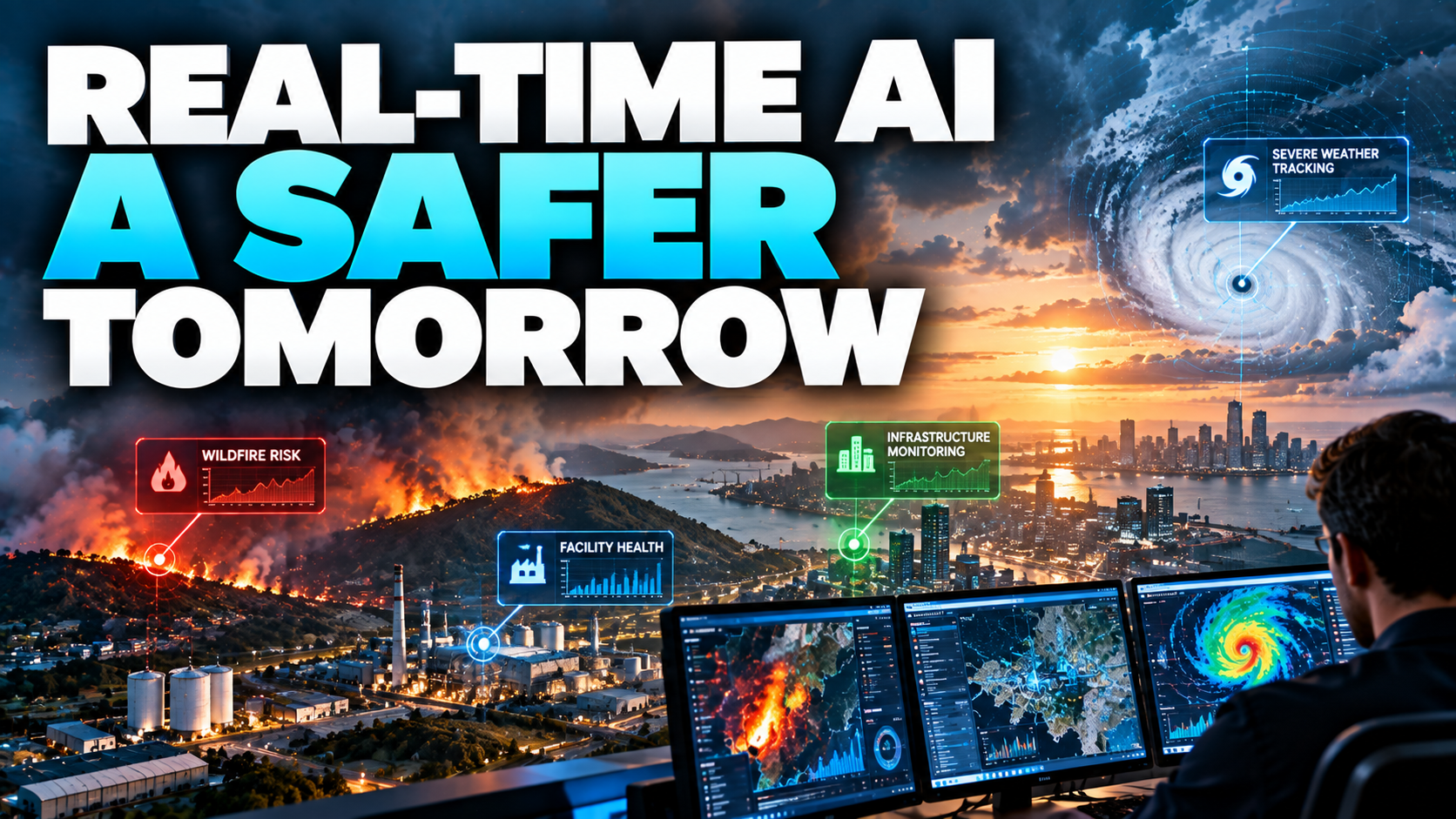
Imagine a large industrial facility filled with sensors continuously collecting environmental and operational information.
Instead of those sensors functioning independently, their information feeds into a centralized platform.
Artificial intelligence analyzes the data.
A digital twin provides a virtual representation of the physical environment.
Algorithms look for changing patterns.
Facility operators receive information that can help them understand risk across the environment.
That’s the direction Roze AI is pursuing.
And it means the company’s technology can potentially sit at the intersection of several rapidly developing markets: artificial intelligence, smart buildings, industrial IoT, digital twins and next-generation safety infrastructure.
The Technology Is Already Moving Beyond the Lab
This isn’t simply a concept Roze AI hopes to develop someday.
According to the company’s Nasdaq announcement, its technologies have already been installed across government facilities, military bases, manufacturing sites and power plants in South Korea. GlobeNewswire
That’s an important part of the story.
Roze AI isn’t beginning with a blank sheet of paper after arriving on Nasdaq.
It enters the U.S. public market with operating technology, existing installations and a business already participating in fire-detection and safety infrastructure.
The company also manufactures automatic fire detectors and wireless communications devices and designs firefighting systems. Benzinga
That creates an interesting bridge between the company’s established physical safety products and its expanding AI ambitions.
Hardware generates information.
Sensors connect the physical environment.
Software organizes the information.
Artificial intelligence analyzes it.
And Fire 4Cast attempts to turn those signals into actionable intelligence.
Artificial Intelligence Meets Digital Twins
Digital-twin technology makes this concept even more interesting.
A digital twin is essentially a digital representation of a physical asset, system or environment.
When combined with continuously updated sensor information, a digital twin can give operators a dynamic picture of what’s happening inside a facility.
Add artificial intelligence and the system can begin analyzing patterns across that information.
For disaster prevention, that opens an entirely different way of thinking about infrastructure.
Instead of asking:
“Has something gone wrong?”
The more powerful question becomes:
“Are conditions developing that suggest something could go wrong?”
That distinction sits at the heart of Roze AI’s technology story.
Nasdaq Gives Roze AI a Global Stage
Roze AI’s September 29 announcement specifically connected the Nasdaq listing with the company’s plans for international expansion. GlobeNewswire
That’s significant because the technology addresses a problem that isn’t geographically limited.
Factories need fire protection.
Power plants need monitoring.
Government facilities need safety systems.
Military installations need infrastructure intelligence.
Commercial buildings need fire detection.
Industrial facilities need better information about what’s happening inside increasingly complicated operating environments.
Roze AI’s existing installations are concentrated in South Korea, but Nasdaq introduces the company to an international capital-market audience at precisely the moment it is positioning the technology for a larger global opportunity.
Roze AI Is Expanding the Technology Stack
Fire 4Cast isn’t the only technology appearing in Roze AI’s product portfolio.
The company’s own website currently highlights So.S HOME, which it describes as an all-in-one safety system powered by sound-field security sensors, as well as EnerGen, an AI system-on-chip initiative aimed at disaster-care and electrical-power-generation applications. RozeAI
Taken together, these products suggest something larger than a single fire-prediction application.
Roze appears to be building an ecosystem around intelligent physical safety.
Sensors.
Communications.
Artificial intelligence.
Semiconductors.
Digital twins.
Monitoring.
Prediction.
That is what makes the company interesting from a technology perspective.
The Bigger Idea: Detect, Predict, Prevent
The progression is straightforward:
Detect. Predict. Prevent.
For decades, much of physical safety infrastructure has focused heavily on the first step.
Detect smoke.
Detect heat.
Detect an alarm condition.
Roze AI is attempting to push intelligence farther upstream.
The company’s technology is designed to collect information continuously and use artificial intelligence to understand what those signals could mean before a traditional alarm condition develops.
If that model continues expanding, the potential applications become much broader than a conventional fire alarm.
Industrial plants.
Energy infrastructure.
Commercial buildings.
Warehouses.
Transportation facilities.
Military installations.
Large residential developments.
Smart cities.
Any environment filled with connected sensors becomes a potential source of intelligence.
And that may be the most compelling part of the Roze AI story.
Seven Days Changed the Visibility of Roze AI
When Small Cap Exclusive first covered Roze AI on September 25, our headline asked:
Can AI predict disasters before they happen?
At the time, the company hadn’t yet begun public trading.
Four days later, RZAI arrived on Nasdaq. GlobeNewswire
Two days after that, the shares had reached $42 during premarket trading, drawing considerably more attention to both the ticker and the company behind it. Public
That’s an extraordinary change in visibility over a remarkably short period.
But the technology story underneath it hasn’t changed.
Roze AI is still pursuing the same ambitious idea we examined before its Nasdaq debut:
Use sensors to understand the physical world.
Use artificial intelligence to interpret what those sensors are seeing.
Use digital twins to create intelligence around physical environments.
And use that information to help people recognize danger earlier.
The Nasdaq listing gives that mission a larger stage.
The market’s early reaction has given Roze AI stock RZAI considerably more visibility.
Now a company that was largely unknown to U.S. public-market audiences only days ago has a Nasdaq ticker—and a much bigger audience watching what comes next.
PAID ADVERTISEMENT. Small Cap Exclusive is owned and operated by King Tide Media, LLC. Hatcher Group Limited is the paying party for this investor-awareness campaign relating to Roze AI Inc. (NASDAQ: RZAI). King Tide Media, LLC may receive compensation of up to $1,000,000 in connection with this campaign, which commenced September 25, 2026. Full Disclaimer