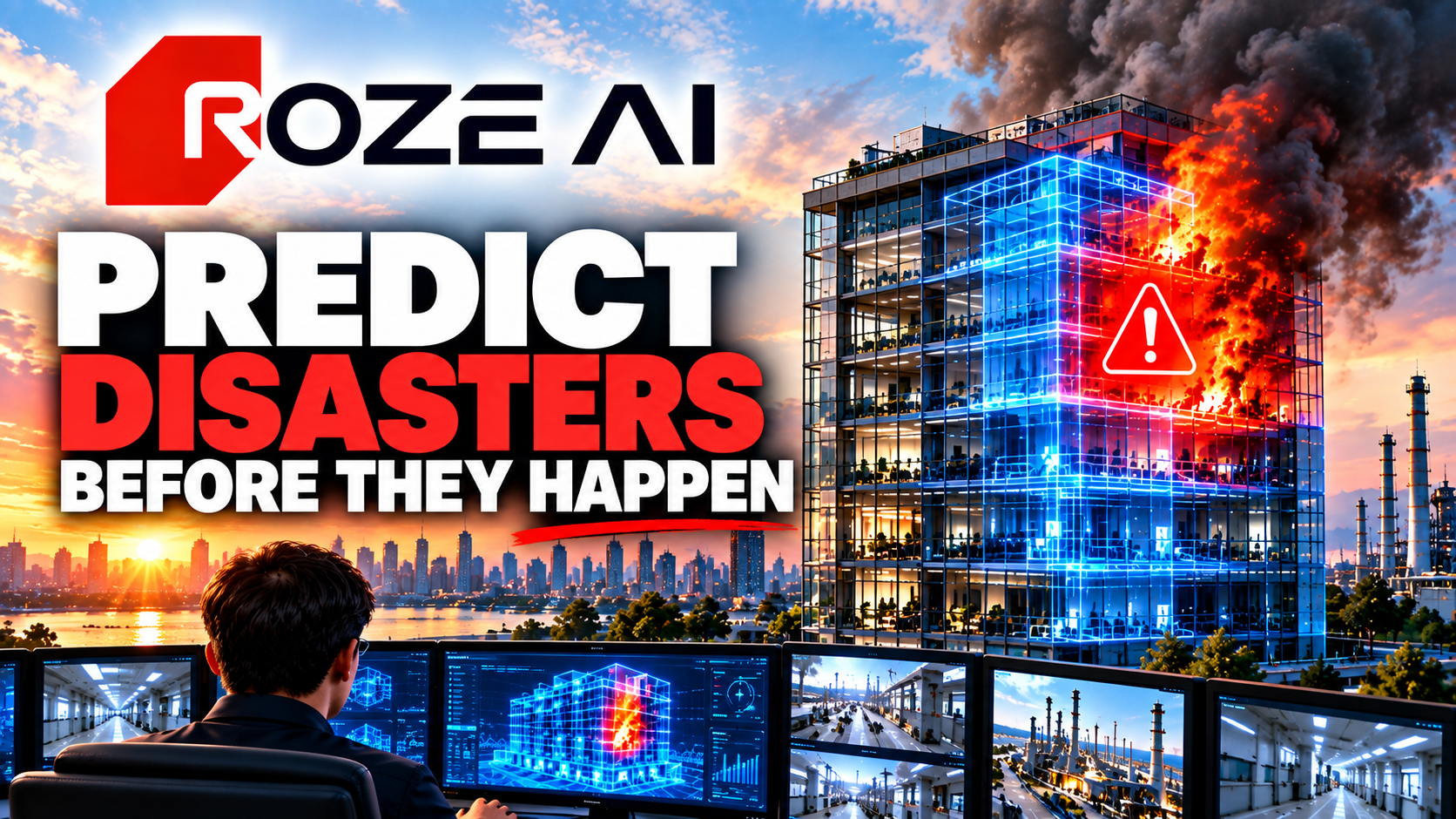
Most fire and disaster systems are designed to tell us when something has already gone wrong. Roze AI is building a different kind of safety platform — one that combines sensors, artificial intelligence and digital twins to identify risk earlier and potentially intervene before an incident escalates.
Artificial intelligence is rapidly changing the digital world.
It can write. Code. Generate images. Analyze enormous datasets. Help researchers discover new drugs.
But some of the most interesting applications of AI may ultimately happen far away from a computer screen.
What if AI could help predict a fire before it happens?
What if a building could continuously analyze its own temperature, smoke, gases, electrical conditions and other environmental signals — looking not simply for a disaster, but for patterns that could precede one?
That’s the problem Roze AI has spent years trying to solve.
The South Korean technology company operates at the intersection of artificial intelligence, physical infrastructure and disaster safety. Its underlying idea is straightforward but ambitious:
Move safety systems from reaction toward prediction.
Roze AI says its technology continuously analyzes real-world environments using wireless sensors and AI-driven models, with the goal of identifying risks early enough to enable intervention before an incident escalates. Pasted markdown
And this isn’t simply a concept being developed in a lab.
According to company materials, Roze technology has been deployed across critical infrastructure including military bases, international airports and power plants, along with manufacturing, logistics, energy, commercial and public environments. Pasted markdown
The Problem Isn’t Detection. It’s Timing.
ROZE AI fire prevention
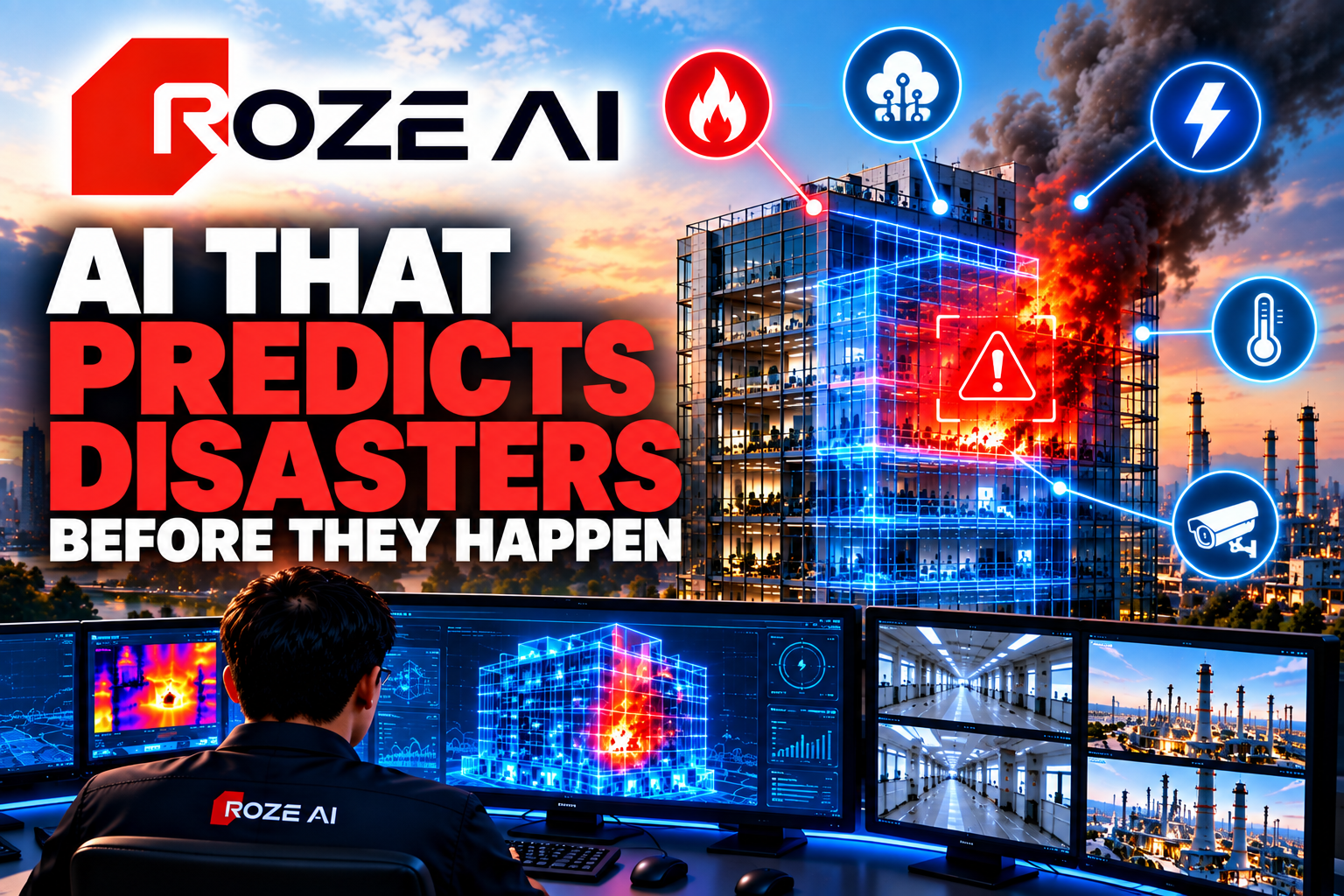
ROZE AI fire prevention
That line from Roze AI’s presentation gets to the heart of the company.
Traditional fire and safety systems have historically been designed around detection.
Smoke appears. Heat rises. An alarm is triggered. People respond.
All of those steps are essential. But they generally occur once dangerous conditions have already developed.
Roze AI is trying to move that timeline backward.
Its platform continuously collects information from physical environments and uses artificial intelligence to analyze changing conditions and anomalies. The company’s stated objective is to identify risk before an incident occurs, potentially creating an earlier window for intervention. ROZE_AI_-_Corporate_Presentation
That changes the fundamental question from:
“Is there a fire?”
to:
“Are conditions developing that indicate an elevated risk of fire?”
That’s a much more ambitious technological challenge.
It’s also where Roze believes artificial intelligence could fundamentally change the safety industry.
Inside Roze AI’s Technology
ROZE AI fire prevention
Roze AI isn’t building a single smart smoke detector.
The company has developed a broader technology stack connecting the physical and digital worlds.
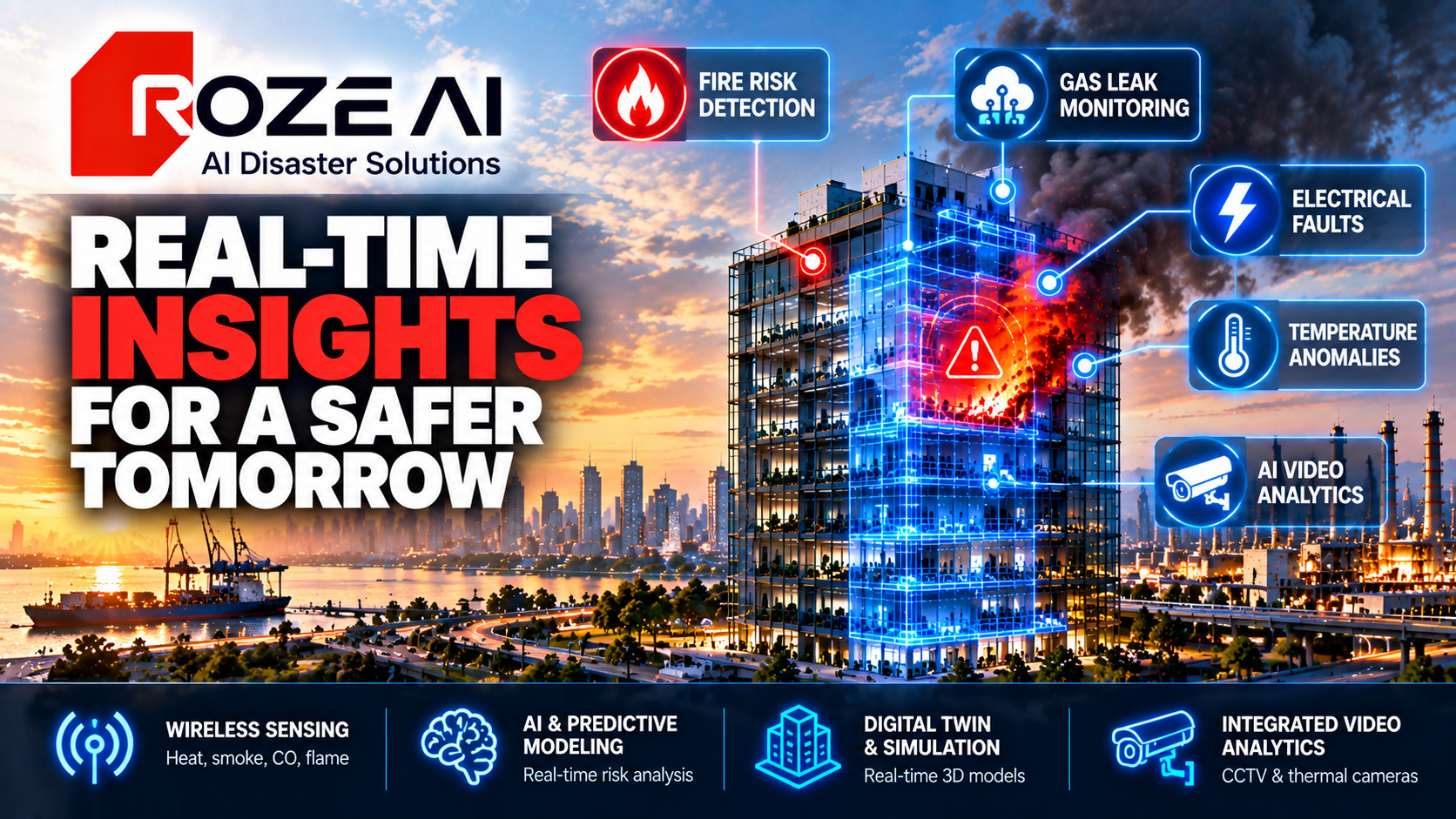
At the physical layer are wireless sensors capable of collecting environmental information such as heat, smoke, carbon monoxide and flame data.
That information can feed into DAP — the Disaster AI Platform, which provides centralized monitoring and real-time risk dashboards. AI models continuously analyze incoming information for anomalies and changing risk conditions. Pasted markdown
The company can also integrate CCTV and thermal cameras, applying deep-learning models to video for fire and flame detection.
Then there are digital twins.
Roze can create virtual representations of buildings, individual zones and equipment and connect those models to live sensor information. Its technology can then visualize changing conditions and simulate potential fire scenarios. Pasted markdown
Roze’s public technology materials also describe systems that analyze electricity, gas, pressure, vibration, temperature and humidity to derive disaster-risk indicators. Its DAP platform is designed to combine sensor information, video analysis, machine learning and automated alerts into a broader disaster-management system. RozeAI
Taken together, Roze is essentially trying to build an intelligence layer for physical infrastructure.
Digital Twins Could Make Buildings Smarter About Risk
Digital twins are an especially interesting part of the Roze AI story.
A digital twin is essentially a virtual representation of a physical environment that changes as the real environment changes.
Roze says its system can connect building sensors, cameras and other systems to a digital model, allowing operators to monitor conditions and simulate responses.
The company says it has developed digital-twin-based integrated disaster-prevention systems for projects involving South Korean Air Force infrastructure and thermal power generation. Its public materials describe systems combining multi-sensor fire detection, CCTV analysis, real-time monitoring, evacuation guidance and machine-learning risk models. RozeAI
That potentially turns a building from something operators simply monitor into an environment that continuously produces information about its own risk profile.
And the concept isn’t limited to fire.
Roze says its systems can analyze hazards involving gas, electrical faults, temperature changes and other environmental conditions. Pasted markdown
Roze AI Has Been Building This for More Than a Decade
One thing separating Roze AI from many companies emerging during the current AI boom is timing.
The company was established in 2015. Pasted markdown
That means its underlying business predates the explosion of consumer interest in generative AI by years.
Founder and CEO Young Jin Cho began his career as a semiconductor design engineer in Silicon Valley and later founded the company after more than two decades of experience in information technology. ROZE_AI_-_Corporate_Presentation
The company has since expanded beyond conventional fire detection into AI modeling, IoT sensing, digital twins, video analytics and specialized hardware.
Roze’s corporate materials say its systems are now used across thousands of commercial and public locations and have operated in manufacturing, logistics and energy environments in addition to national infrastructure. Pasted markdown
Those are company-reported deployment figures, but they illustrate something important about the story:
Roze isn’t trying to invent a market around a newly created AI product. It’s attempting to apply AI to a safety market that has existed for generations.
There’s a Business Model Behind the Technology
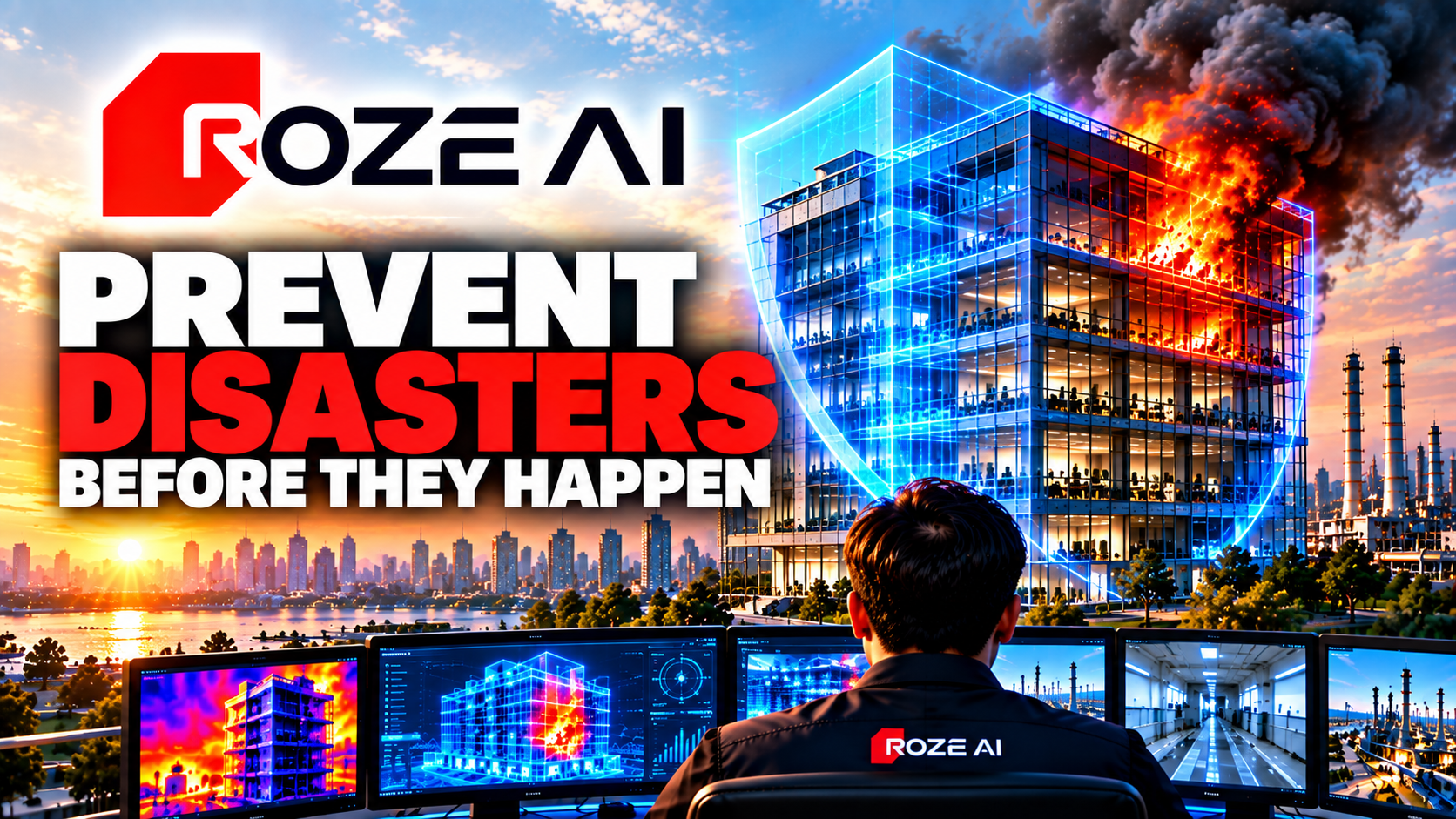
ROZE AI fire prevention
The company primarily targets business and government customers, including developers, infrastructure operators and public agencies.
Roze describes its revenue model as a combination of hardware deployment, platform licensing, and recurring monitoring and analytics services. Pasted markdown
That’s an interesting structure.
Hardware gets Roze physically embedded inside infrastructure.
Software connects those systems.
Monitoring and analytics potentially extend the relationship after installation.
And as sensors continue generating information, the company believes accumulated data can improve its models over time. Its materials describe this as a potential data flywheel, alongside proprietary AI and hardware and full-stack integration. Pasted markdown
The company also reports substantial contracted business. Its August 2026 materials state C$300 million+ in signed contracts and a company target of $1.4 billion by 2027. Pasted markdown
Those numbers require an important caveat.
Many contracts are connected to large construction and development projects and span multiple years. Roze explicitly says revenue is recognized as the physical development of those projects progresses — not when a contract is signed. Pasted markdown
So contracted value shouldn’t be confused with current revenue.
Execution remains the important part.
From Korea to a Much Larger Market
Roze AI’s ambitions extend well beyond its home market.
Company materials identify strategic relationships or initiatives involving organizations in Vietnam, Bangladesh, Saudi Arabia, Finland, Ukraine, Uzbekistan, Mongolia and the Philippines. Pasted markdown
The opportunity Roze is pursuing is easy to understand.
Factories need safety systems. So do airports. Power plants. Military facilities. Apartment buildings. Logistics centers. Cities.
As these environments become increasingly connected, the amount of real-time data available to safety systems grows dramatically.
Roze’s thesis is that the next generation of those systems won’t simply wait for an alarm condition.
They’ll continuously interpret the environment around them.
From Detecting Disaster to Anticipating It
There are still plenty of questions Roze AI will have to answer as it scales.
Can large contracted projects consistently become recognized revenue? Can the company reproduce its Korean deployments internationally? Can recurring software, monitoring and analytics become a larger part of its business? Can predictive models demonstrate meaningful real-world advantages over conventional safety systems? And can Roze scale a business combining hardware, software, AI and major infrastructure deployments without losing focus?
Those are meaningful execution challenges.
But the underlying idea is compelling precisely because it’s so easy to understand.
For generations, safety technology has largely answered one question:
What is happening right now?
Roze AI is working toward a more difficult one:
What might happen next?
If artificial intelligence is going to become deeply integrated into the physical world, predicting and preventing disasters may prove to be one of its most consequential applications.
And that’s the opportunity Roze AI has spent more than a decade building toward.