
After a 63% plunge, Roze AI’s growing South Korean project pipeline and three emerging technical signals are giving traders reasons to take another look.
But is the stock finally stabilizing?
What happens when a newly listed AI company loses nearly two-thirds of its market value while announcing substantial new commercial opportunities?
That’s the question surrounding Roze AI (NASDAQ: RZAI).
DISCLAIMER: This article is for informational purposes only and does not constitute investment advice or a recommendation to buy or sell securities. Investing involves risk, including possible loss of principal. Market conditions can change rapidly. Please conduct your own due diligence. Read our full disclaimer.
Between October 1 and October 16, RZAI shares declined from $26.31 to $9.82—a drop of approximately 63%.
Yet while the stock was falling, Roze AI was announcing additional South Korean projects involving AI-powered fire-risk monitoring, digital twins, and disaster-prevention technology.
The company’s recent announcements include approximately $27 million in six new project contracts, while its previously disclosed Daegu AI Data Center agreement carries a stated value of approximately $172.2 million, including VAT, according to the company’s October 19 clarification. (See Disclaimer Below: 1)
These figures are significant relative to Roze AI’s approximately $2.3 million in reported 2025 revenue.
But there’s a critical distinction: announced project values are not recognized revenue, and several projects remain dependent on financing, construction schedules, and other conditions.
Meanwhile, RZAI’s trading activity has begun showing three technical characteristics sometimes associated with an emerging stock-price bottom.
The combination creates an intriguing question for traders: Could the selling pressure be approaching exhaustion just as the company’s commercial pipeline expands?

The Business Catalyst: Roze AI’s South Korean Project Pipeline
Roze AI develops technology designed to help buildings and infrastructure operators identify fire risks before emergencies develop.
Its Fire 4Cast system and Disaster AI Platform combine wireless sensors, artificial intelligence, and digital-twin technology to analyze facility conditions and identify potential hazards.
Recent announcements suggest the company is pursuing larger commercial deployments.
Approximately $27 Million in Recently Announced Contracts
On October 6, Roze AI announced three South Korean development contracts valued at approximately $12.2 million excluding VAT, or $13.4 million including VAT.
On October 13, the company announced three additional contracts worth approximately $14.8 million, including VAT.
Together, the six agreements represent approximately $28.2 million including VAT, commonly described as roughly $27 million when combining the releases’ headline dollar amounts.
The projects involve redevelopment and commercial properties in Seoul and Incheon. Construction is currently expected to begin during the first half of 2027, subject to project conditions.
October 19: The $172.2 Million Daegu Clarification
Roze AI also provided updated information concerning its previously disclosed Daegu AI Data Center agreement.
According to the company’s clarification, the agreement carries a stated value of approximately KRW 230.94 billion, or $172.2 million including VAT.
Importantly, this is not a newly awarded contract or an increase in the original Korean-won agreement. The updated U.S. dollar figure reflects VAT treatment and currency conversion.
Physical project operations have not commenced, no revenue has been recognized, and execution remains contingent on financing and other conditions.
The distinction matters. The potential project scale is substantial, but the company must still demonstrate its ability to turn announced agreements into completed, revenue-generating work.
For investors, the opportunity lies in potential future execution—not in treating the full headline amount as revenue already earned.
Three Technical Signals Suggest RZAI May Be Building a Bottom
The fundamental story is only half the picture.
Following its steep decline, RZAI’s most recent completed trading sessions show three technical developments worth examining.
None proves that the bottom is in. Together, however, they provide a framework for evaluating whether the stock is beginning to stabilize.
Signal #1: Buyers Are Beginning to Defend the Lows
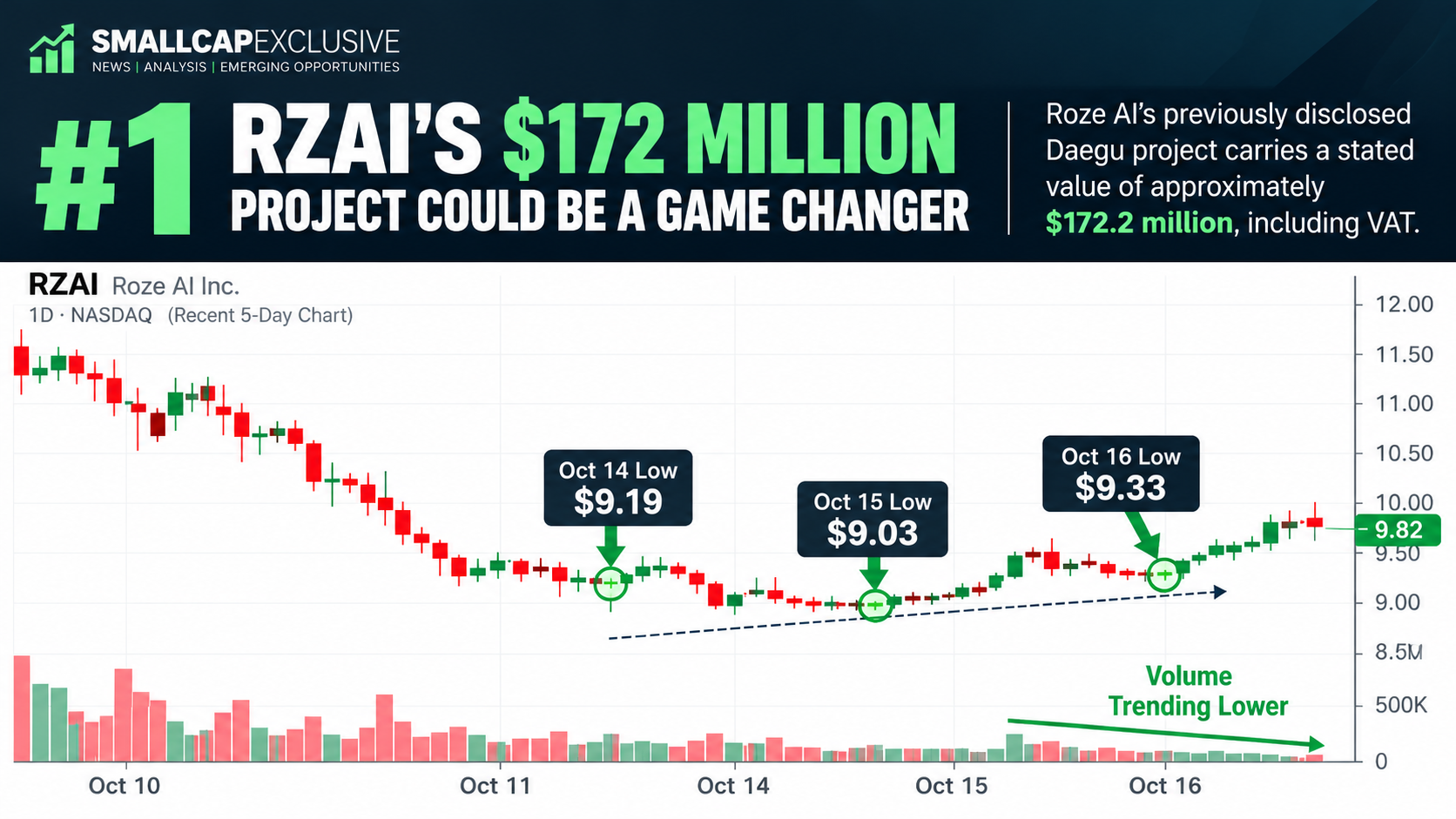
On October 15, RZAI traded as low as $9.03 before recovering to close at $9.81.
On October 16, its intraday low increased to $9.33, and the stock closed at $9.82.
That gives the stock a higher latest intraday low and two consecutive higher closing prices.
For technical traders, this matters because a potential reversal often begins when sellers fail to establish fresh lows.
The pattern is still preliminary. A stronger signal would require RZAI to sustain higher lows and eventually move above recent resistance.
The key observation: The stock’s latest session did not revisit the previous day’s low.
Signal #2: Volatility Is Contracting
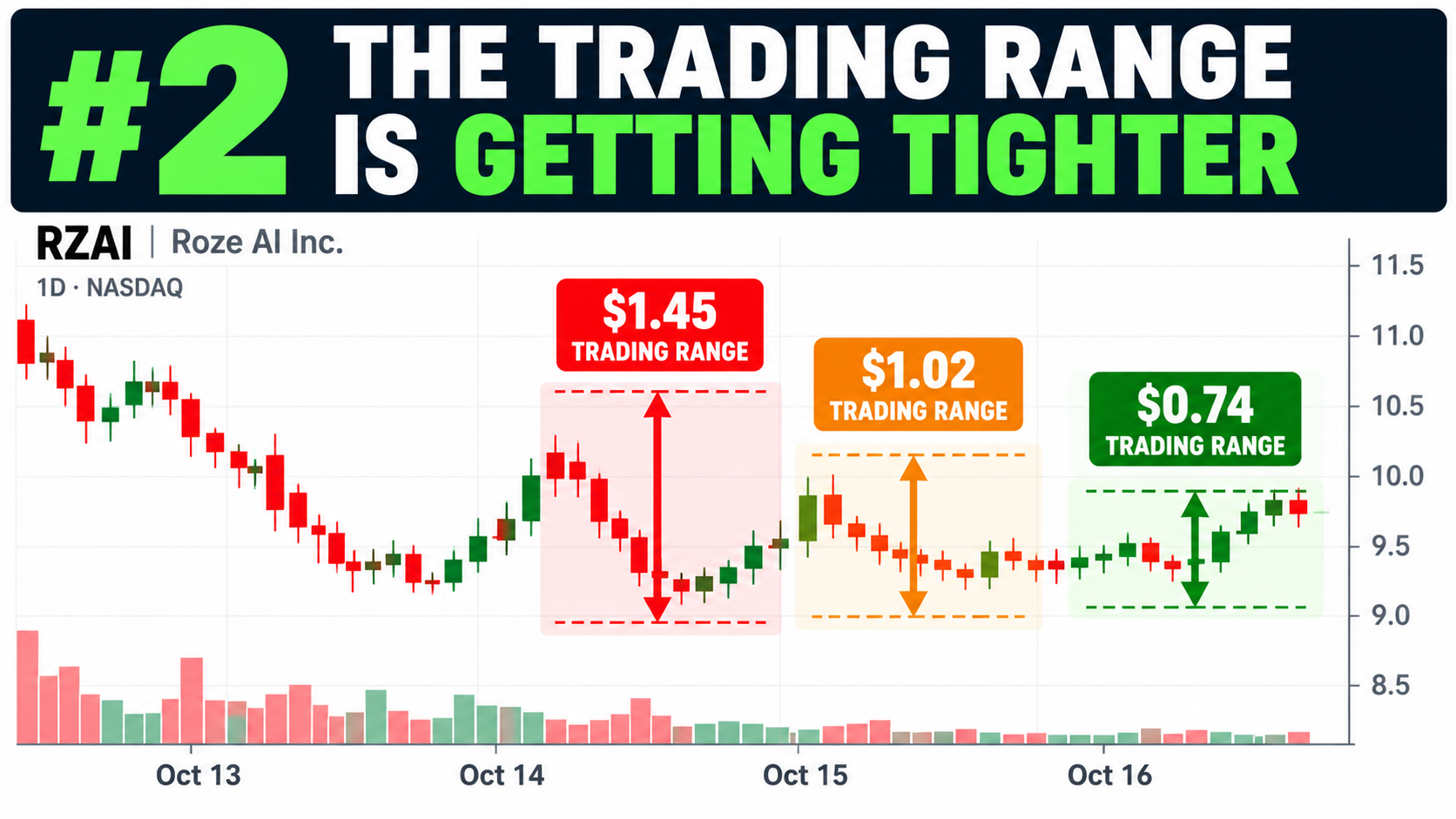
RZAI’s daily trading range narrowed across three consecutive sessions:
| Date | Daily trading range |
|---|---|
| October 14 | $1.45 |
| October 15 | $1.02 |
| October 16 | $0.74 |
The October 16 session also produced the narrowest trading range of the preceding seven sessions, commonly called an NR7 pattern.
After a sharp selloff, this type of volatility compression can indicate that the market is transitioning from aggressive selling toward consolidation.
The next directional move remains uncertain.
A breakout accompanied by renewed buying volume would strengthen the bullish interpretation. A breakdown below recent support would undermine it.
The key observation: RZAI’s daily price swings have become considerably smaller.
Signal #3: Trading Volume Has Declined Approximately 92%
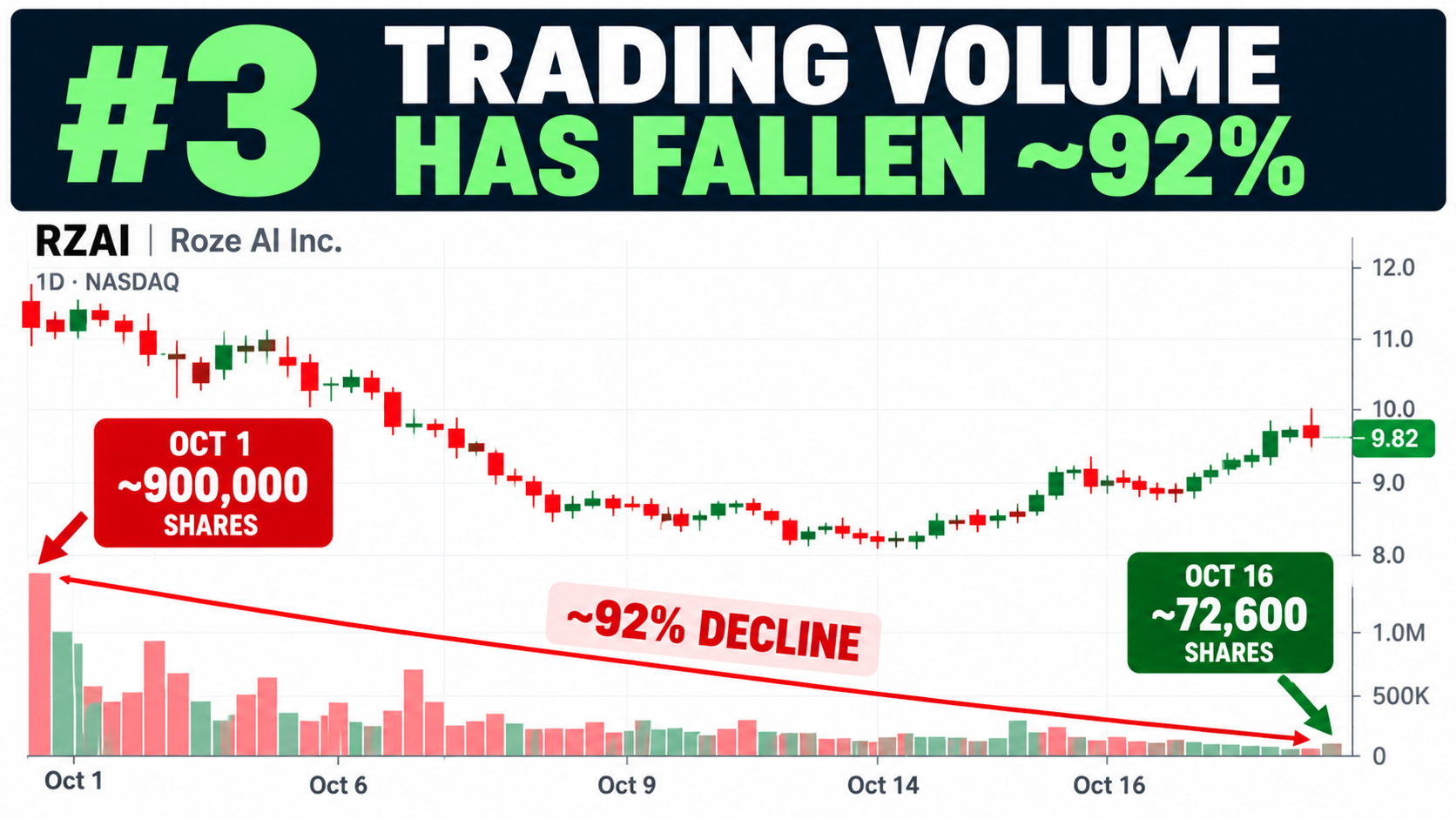
On October 1, approximately 900,000 RZAI shares changed hands.
By October 16, daily volume had fallen to approximately 72,600 shares.
That’s a decline of roughly 92%.
Falling volume after an aggressive selloff can indicate that selling activity is subsiding.
However, it can also reflect reduced liquidity and declining investor interest. Low volume alone is not evidence that institutional investors are accumulating shares.
For traders, the more meaningful development would be renewed buying interest accompanied by a sustained improvement in price.
The key observation: Trading activity has diminished sharply as the stock’s price range has tightened.
What Would Confirm a More Convincing RZAI Reversal?
The three technical signals suggest possible stabilization, but they do not yet establish a confirmed uptrend.
Traders evaluating RZAI’s next move may want to monitor whether the stock can hold its recent lows, break above nearby resistance, and attract stronger buying volume.
The business story also has important milestones ahead.
Progress on project financing, construction commencement, contract execution, and actual revenue recognition would provide more meaningful evidence of commercial momentum than headline contract values alone.
That distinction is particularly important for a company with a relatively small historical revenue base and exposure to financing, dilution, execution, and liquidity risks.
A potentially improving chart and a growing announced pipeline can coexist with substantial financial uncertainty.
Following RZAI? Don’t Miss the Next Development.
Get free RZAI breaking-news alerts, technical updates, and emerging-stock coverage from SmallCapExclusive.
Follow the company’s project milestones and evolving stock chart as new information becomes available.
The Bigger Picture: Is RZAI Approaching a Turning Point?
RZAI presents two developments worth watching.
On the business side, Roze AI has announced additional South Korean contracts and clarified the substantial stated value of its previously disclosed Daegu project agreement.
On the technical side, the stock has produced a higher latest intraday low, narrowing daily trading ranges, and sharply reduced volume following a roughly 63% decline.
That combination makes RZAI a candidate for further research—not a confirmed recovery.
The central question is whether the company can convert its commercial opportunities into recognized revenue while the stock develops a more durable pattern of buying support.
For traders studying potential post-selloff reversals, those are the developments that matter.
RZAI has already experienced the dramatic decline. What happens next will depend on both the chart and the company’s execution.
Add RZAI to Your Research Watchlist
Follow SmallCapExclusive for updates on Roze AI’s South Korean projects, technical price levels, and other emerging small-cap opportunities.
PAID ADVERTISEMENT. Small Cap Exclusive is owned and operated by King Tide Media, LLC. SGNL Media Group LLC is the paying party for this investor-awareness campaign relating to Roze AI Inc. (NASDAQ: RZAI). King Tide Media, LLC may receive compensation of up to $1,000,000 in connection with this campaign, which commenced September 25, 2026. Full Disclaimer
This content is a paid investor-awareness advertisement, not independent investment research or a recommendation to buy or sell securities. Project values are not revenue guidance. Stock-price patterns do not guarantee future performance.
1 Project Value Clarification: The approximately $172.2 million Daegu AI Data Center contract was previously disclosed by Roze AI. The updated U.S. dollar figure reflects the inclusion of VAT and a different currency exchange rate, not a new contract award or an increase in the Korean-won contract value. Project operations have not commenced, related revenue has not been generated, and financing has not yet been secured. The stated amount is not revenue guidance.