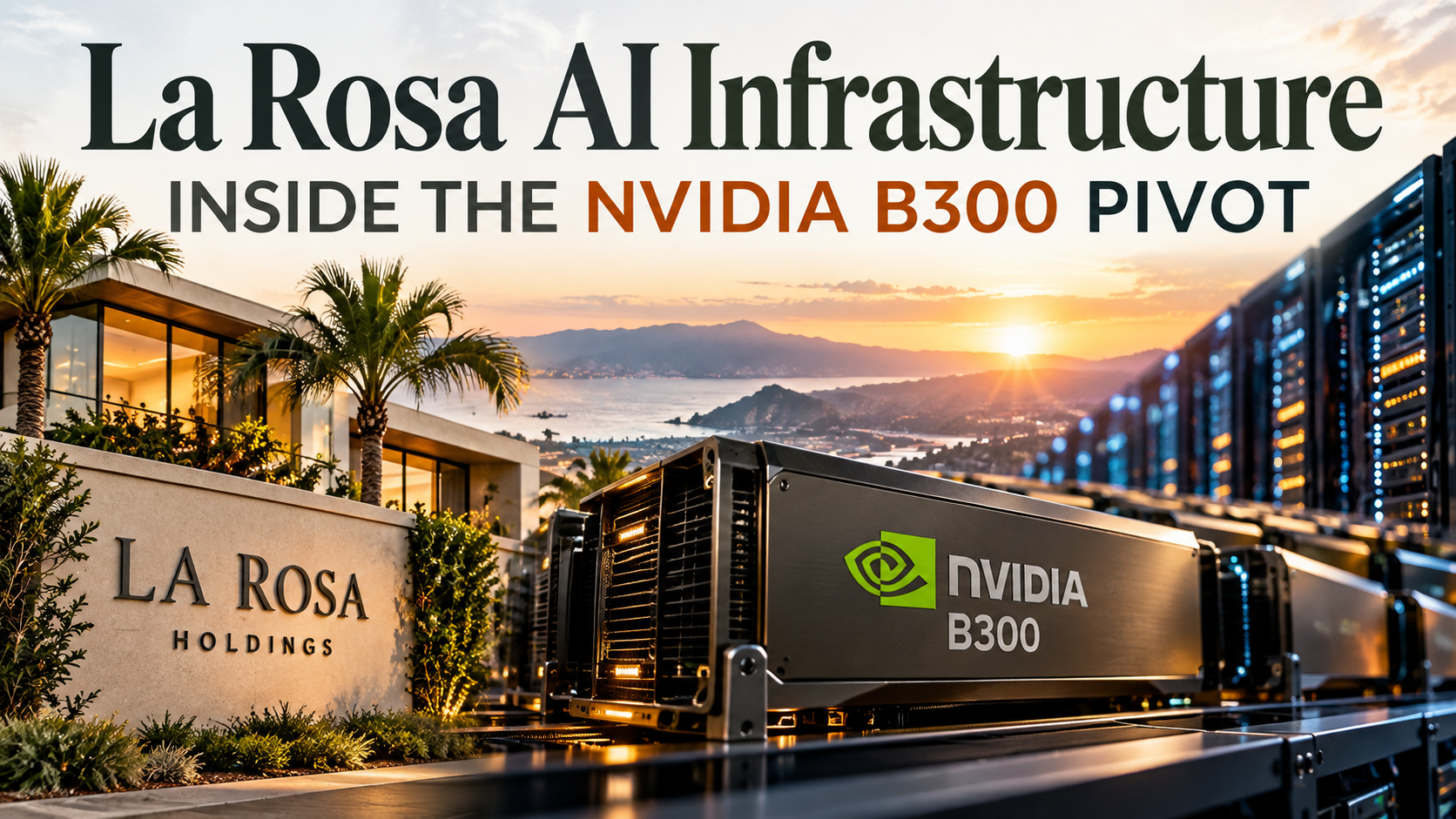
La Rosa AI infrastructure is suddenly becoming the story behind a company long associated with real estate and PropTech. After acquiring NVIDIA B300 GPUs and placing them under a long-term lease, La Rosa Holdings is now evaluating whether to divest its existing real-estate businesses as it shifts its attention toward the physical infrastructure powering artificial intelligence.
A real-estate company buying some of NVIDIA’s newest AI processors sounds, at first, like one of those headlines that requires a second read.
But that’s essentially what happened this week.
La Rosa Holdings Corp. (NASDAQ: LRHC), historically a real-estate brokerage and PropTech business, announced October 1 that it acquired NVIDIA B300 graphics processing units and leased the assets under a long-term arrangement that the company expects will generate recurring cash flow.
At the same time, La Rosa said it is evaluating strategic alternatives for its existing real-estate operations, including a potential divestiture.
The company also changed its leadership and said it eventually intends to change both its corporate name and Nasdaq ticker as part of the transformation. GlobeNewswire
That’s considerably more than adding an AI product to an existing business.
La Rosa AI infrastructure appears to be developing into an attempted reinvention of the company itself.
And it comes at a fascinating moment for the broader AI industry.
La Rosa AI Infrastructure Starts With NVIDIA B300 GPUs
The centerpiece of the announcement is hardware.
La Rosa says it acquired NVIDIA B300 GPUs, which are designed for demanding artificial-intelligence and high-performance-computing workloads.
The company subsequently placed those assets under a long-term lease arrangement.
According to La Rosa, the lease is expected to establish a recurring, long-term cash-flow stream while giving the company a foundation from which to expand its AI infrastructure strategy. GlobeNewswire
That distinction matters.
La Rosa isn’t simply announcing that it plans to “use AI” inside its existing real-estate operation.
It’s acquiring the physical computing hardware used to run AI workloads.
That’s an entirely different business proposition.
AI models may be software, but running increasingly sophisticated models requires a growing physical ecosystem underneath them: GPUs, data centers, electricity, cooling, networking and specialized infrastructure.
The La Rosa AI infrastructure strategy is attempting to move the company directly into that physical layer.
Why NVIDIA B300 Changes the Story
NVIDIA has become central to the infrastructure behind modern artificial intelligence, and La Rosa’s decision to acquire B300 GPUs places the company’s first major AI move firmly on the hardware side of the industry.
The strategy is relatively straightforward on paper.
Acquire high-performance computing assets.
Lease those assets.
Generate recurring cash flow.
Then potentially use that foundation to expand further into AI infrastructure.
La Rosa described the B300 assets as a foundational compute layer from which it can build a broader infrastructure footprint. GlobeNewswire
What remains unknown is equally important.
The October 1 announcement did not disclose the financial terms of the GPU acquisition, meaning readers do not yet have enough information from that announcement alone to determine the economics of the transaction. citybiz
That makes the coming disclosures particularly important.
How much did the hardware cost?
How is it financed?
What are the economics of the lease?
How quickly can the strategy scale?
Those questions will ultimately matter more than the words “NVIDIA B300” appearing in a press release.
La Rosa AI Infrastructure Could Replace Its Legacy Business
This is where the story becomes unusual.
La Rosa isn’t merely expanding into a new vertical while leaving everything else untouched.
The company said it intends to evaluate strategic alternatives for its existing real-estate operations, including a potential divestiture of those businesses.
Management said monetizing the legacy assets could free additional capital and resources for the company’s transition toward AI infrastructure. GlobeNewswire
For context, La Rosa’s existing operations include residential and commercial real-estate brokerage, franchising, education and coaching, property management and technology-driven services for agents. Its corporate website still describes a network of more than 3,100 agents and 25 offices. La Rosa Holdings
That’s what makes this transformation worth following.
The company isn’t moving from one adjacent technology category into another.
It’s attempting to move from selling and servicing real estate to owning computing infrastructure used for artificial intelligence.
That’s a substantial change in direction.
New Strategy, New Leadership
The strategic shift is also reaching the executive suite.
La Rosa announced that Chairman Nicholas Adler became chief executive officer and interim chief financial officer effective October 1.
Founder and former CEO Joe La Rosa stepped down from the CEO position to lead the company’s real-estate business while remaining on the board. GlobeNewswire
The arrangement makes sense in the context of the broader transition.
The legacy business still exists.
But the parent company’s strategic focus is moving elsewhere.
La Rosa has gone so far as to say it intends to change its corporate name and Nasdaq ticker, with additional information expected as the board determines the appropriate next steps. GlobeNewswire
A ticker change by itself doesn’t create a new business.
But combined with a new CEO, GPU acquisition, long-term equipment lease and potential divestiture of the company’s historical operations, it illustrates the scale of the transformation management is contemplating.
The La Rosa AI Infrastructure Pivot Didn’t Appear Overnight
Yesterday’s announcement may look sudden, but La Rosa had already been signaling that something larger was developing.
Its corporate website now describes the company as advancing an AI infrastructure strategy and developing what it calls a portfolio of data-center facilities optimized for AI workloads. La Rosa Holdings
Earlier this year, however, the company was still overwhelmingly identified with real estate and PropTech.
For fiscal 2025, La Rosa reported approximately $68.5 million in revenue, while its first-half 2026 results showed continued activity across its existing real-estate operations. La Rosa Holdings
So this isn’t the story of an established AI infrastructure company adding another GPU deployment.
It’s the story of an existing public company attempting to transform itself into something fundamentally different.
That creates opportunity for an interesting business experiment — but also substantial execution risk.
AI Is Becoming a Physical Infrastructure Business
La Rosa’s transformation also fits into a much larger shift taking place across artificial intelligence.
The first chapter of the AI boom was dominated by software.
Chatbots.
Large language models.
Image generators.
Coding assistants.
AI agents.
But every one of those applications ultimately depends on physical computing infrastructure.
At the simplest level, the chain looks something like this:
Electricity → Data Center → Cooling → GPU → Network → Model → Application
The enormous demand for artificial intelligence has therefore created another race underneath the software race: the competition to provide the computing capacity required to run it.
That’s the market the La Rosa AI infrastructure strategy is attempting to enter.
And unlike launching another AI application, participating at the infrastructure layer requires substantial capital, equipment and operational execution.
The NVIDIA Name Isn’t the Whole Story
The presence of NVIDIA hardware makes for an eye-catching headline.
But the more important question is what La Rosa builds around it.
Owning GPUs does not automatically create a scalable AI infrastructure company.
The business ultimately depends on utilization, customers, lease economics, financing costs, hardware depreciation, access to additional computing capacity and the company’s ability to execute in an industry very different from its historical operations.
Technology also moves quickly.
Today’s high-end AI hardware eventually competes with newer generations.
That means infrastructure owners need to generate sufficient economic value from expensive computing assets while those assets remain commercially attractive.
Those are the questions that will determine whether La Rosa AI infrastructure becomes a meaningful operating business or remains primarily a strategic transition.
What Happens to La Rosa’s Real-Estate Business?
This may be the biggest unresolved question.
La Rosa hasn’t announced that its real-estate operations have been sold.
It has said it is evaluating strategic alternatives, including a possible divestiture. GlobeNewswire
Those are not the same thing.
Until a transaction is actually announced and completed, the real-estate businesses remain part of the broader La Rosa story.
The company also said it could pursue strategic partnerships, investments and additional initiatives designed to expand its presence in the AI ecosystem.
Management even left open the possibility of opportunities in other high-growth sectors. GlobeNewswire
That creates a fairly wide strategic mandate.
For now, the B300 transaction provides something more concrete: actual computing assets and a lease arrangement that management says is intended to produce recurring cash flow.
What Comes Next for La Rosa AI Infrastructure?
This is where the story gets interesting.
The October 1 announcement gives us the beginning of the transformation, but not yet enough information to determine its eventual scale.
The next developments worth following are concrete ones:
The economics of the GPU acquisition and lease.
Additional GPU purchases or computing assets.
Details regarding potential data-center projects.
Customer or infrastructure partnerships.
Financing arrangements.
Any sale or restructuring of the legacy real-estate operations.
And eventually, the company’s proposed new name and Nasdaq ticker.
Those milestones will tell us far more about the La Rosa AI infrastructure strategy than the initial announcement alone.
Because this isn’t simply a story about a real-estate company buying NVIDIA GPUs.
It’s an attempt to change what the company actually is.
Yesterday La Rosa was primarily known as a real-estate and PropTech enterprise.
Today it owns NVIDIA B300 computing assets, has installed new leadership, is considering divesting its legacy operations and says it intends to build around artificial-intelligence infrastructure.
That’s an unusually dramatic corporate transformation.
Now comes the harder part: turning the pivot into an operating business.
Small Cap Exclusive has not received compensation from the company or any third party for the preparation or publication of this article. This is independent editorial content provided for informational purposes only and is not investment advice or a recommendation to buy or sell any security.