
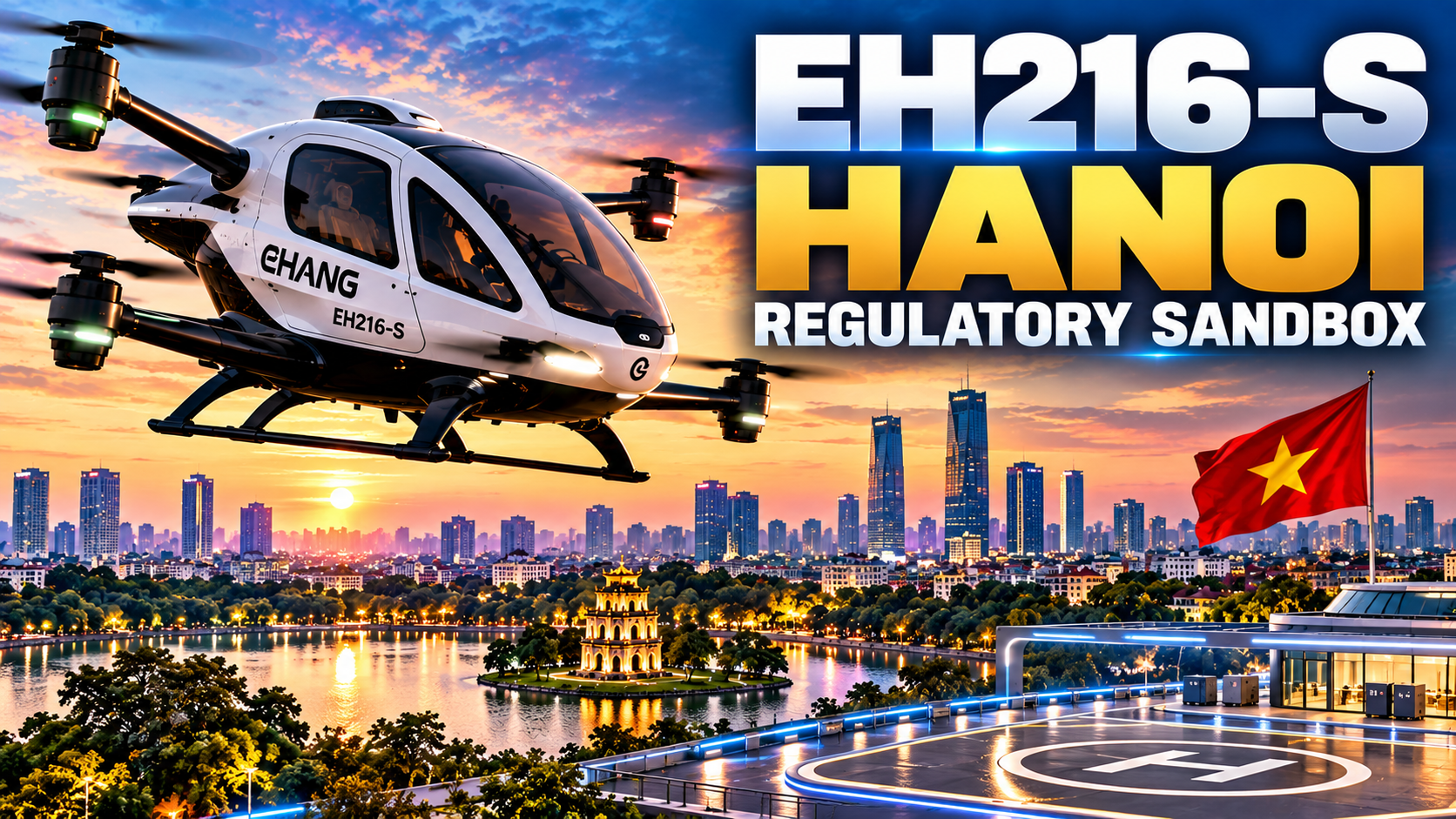
EHang Holdings Limited (NASDAQ: EH) is expanding its international push into Vietnam, EHang Vietnam, where Hanoi is preparing a proposed regulatory sandbox centered on the company’s EH216-S pilotless eVTOL aircraft. It’s not commercial service yet—but it could provide another test of how autonomous air mobility moves from demonstration flights toward regulated operations.
Flying taxis have spent years looking like something perpetually five years away.
Aircraft have flown. Prototypes have improved. Billions of dollars have flowed into advanced air mobility.
But one of the industry’s biggest challenges isn’t simply getting an aircraft into the sky.
It’s getting governments comfortable enough to let these aircraft operate routinely above their cities.
That’s what makes EHang Vietnam an interesting story today.
EHang announced September 29 that Vietnam has become the second country in its Global Fast Track Program, following Sri Lanka. Hanoi is the program’s first stop in Vietnam and represents EHang’s first city-level partnership in the country. EHang
The centerpiece is EHang’s EH216-S, a pilotless passenger-carrying electric vertical takeoff and landing aircraft.
But there’s an important distinction.
Flying taxis aren’t commercially operating in Hanoi today.
The current agreement is intended to establish the framework for controlled testing, regulatory development and operational validation—subject to the required government approvals. EHang
That’s where the story begins.
What Is the EHang Vietnam Agreement?
EHang’s Vietnamese partner, HungViet Technology and Investment Trading JSC, signed a memorandum of understanding with the Hanoi Department of Science and Technology.
Under the agreement, the parties plan to pursue a regulatory sandbox involving eVTOL aircraft, centered initially on the EH216-S.
EHang is expected to provide the aircraft, related technology systems and training support. HungViet is responsible for local implementation, including technical, financial and human resources. EHang
The project is planned for Hoa Lac Hi-Tech Park.
According to Vietnamese government reporting, the proposed program would include controlled EH216-S testing, development of an unmanned-aircraft traffic-management model and creation of an Operations Control Center model. thanglong.chinhphu.vn
ehang-vietnam
The Flights Still Need Approval
This is an important part of the announcement.
HungViet is expected to begin preparing the sandbox program from October 2026, but actual controlled testing can begin only after the necessary application and approval procedures are completed.
Vietnamese government reporting describes the planned testing as a four-stage process. thanglong.chinhphu.vn
So today’s announcement shouldn’t be interpreted as approval for commercial flying-taxi service.
It’s an effort to build the regulatory pathway that could eventually make those operations possible.
Why EHang Vietnam Matters
Regulation may ultimately be one of the biggest competitive barriers in the eVTOL industry.
Building an aircraft that can fly is difficult.
Building one that regulators are willing to certify—and then establishing an operating framework around it—is another challenge entirely.
Airspace rules have to be established.
Traffic has to be managed.
Safety procedures need to be defined.
Operators need training.
Infrastructure needs to exist.
Cities need to determine where aircraft can take off and land.
And all of this becomes particularly interesting when the aircraft is designed to carry passengers without an onboard pilot.
The Hanoi sandbox is intended to examine some of those questions in a controlled environment.
The EH216-S Isn’t Starting From Zero
EHang does have one important advantage as it approaches additional international markets.
The EH216-S has already moved through significant certification processes in China.
According to EHang, the aircraft has received a type certificate, production certificate and standard airworthiness certificate from the Civil Aviation Administration of China.
The company also says the EH216-S has entered operations under China’s first commercial operating qualifications for pilotless passenger-carrying eVTOL aircraft. EHang
That doesn’t automatically translate into authorization in Vietnam.
Vietnam has its own regulatory requirements, and Hanoi’s proposed sandbox still requires approval.
But EHang isn’t approaching the conversation with an aircraft that exists only as a prototype or rendering.
It can bring previous certification and operating experience into discussions with regulators.
EHang Is Building an International Playbook
The broader strategy behind EHang Vietnam may be more important than one city.
EHang launched its Global Fast Track Program in August 2026, with Sri Lanka becoming the first participating country. Vietnam is now the second. EHang
The approach appears designed to connect three things that the eVTOL industry ultimately needs:
Technology. Regulation. Commercial operations.
Rather than simply exporting aircraft, EHang is working with local partners and government authorities to develop testing and regulatory frameworks specific to individual markets.
Hanoi gives the company another place to test that model.
Vietnam Could Extend Beyond Hanoi
EHang’s ambitions aren’t limited to the Vietnamese capital.
The company says it intends to pursue opportunities in other major Vietnamese cities, including Ho Chi Minh City and Da Nang, with potential applications involving urban transportation and tourism. EHang
Those are plans, not established commercial operations.
But if Hanoi’s sandbox progresses successfully, it could provide a framework for discussions elsewhere in the country.
Flying Taxis Aren’t the Only Opportunity
The agreement also goes beyond passenger transportation.
The proposed testing is expected to examine both passenger-carrying and cargo-carrying variants of the EH216 series. EHang
That’s significant because the eventual market for autonomous eVTOL aircraft may not depend entirely on commuters replacing cars with flying taxis.
Potential applications could include logistics, tourism and other low-altitude transportation services.
EHang itself describes a broader portfolio spanning aerial tourism, intra-city transportation, inter-city travel, logistics and emergency applications. EHang
The commercial question is which of those use cases can move from technical possibility to economically sustainable operations.
What Comes Next for EHang Vietnam?
This is where today’s announcement becomes measurable.
First comes the preparation and submission of the sandbox application.
Then Hanoi authorities have to approve the proposed testing.
Only after authorization would controlled EH216-S flights begin at Hoa Lac Hi-Tech Park.
From there, investors can watch whether EHang and its partners successfully establish the proposed traffic-management and operations-control systems, complete technical validation and move discussions toward an eventual commercial framework.
Vietnamese officials have made clear that commercial-model discussions would follow successful testing and evaluation rather than precede them. thanglong.chinhphu.vn
That’s an important distinction.
The Bigger EHang Question
The eVTOL industry doesn’t lack ambitious ideas.
The harder challenge is commercialization.
Can these aircraft operate safely at scale?
Can governments develop workable regulatory frameworks?
Can autonomous aircraft coexist with existing aviation and urban infrastructure?
Can operators make the economics work?
And ultimately, will passengers actually use them?
The EHang Vietnam initiative doesn’t answer those questions yet.
What it does provide is another real-world venue in which EHang and regulators can begin working through them.
For years, the flying-taxi industry has been largely about proving that these aircraft can fly.
The next stage may be proving that cities can actually live with them.
Hanoi could become another test of exactly that.
Editorial Disclaimer
Small Cap Exclusive has not received compensation from EHang Holdings Limited or any third party for the preparation or publication of this article. This article is independent editorial content provided for informational purposes only.
Small Cap Exclusive and King Tide Media, LLC are not registered investment advisers or broker-dealers. Nothing contained in this article constitutes investment, legal, tax or financial advice, or a recommendation or solicitation to buy or sell any security.
Company statements concerning future expansion, regulatory progress, testing, commercialization and potential applications are forward-looking and subject to risks and uncertainties. Readers should independently review company disclosures and applicable regulatory filings and conduct their own due diligence before making financial decisions.