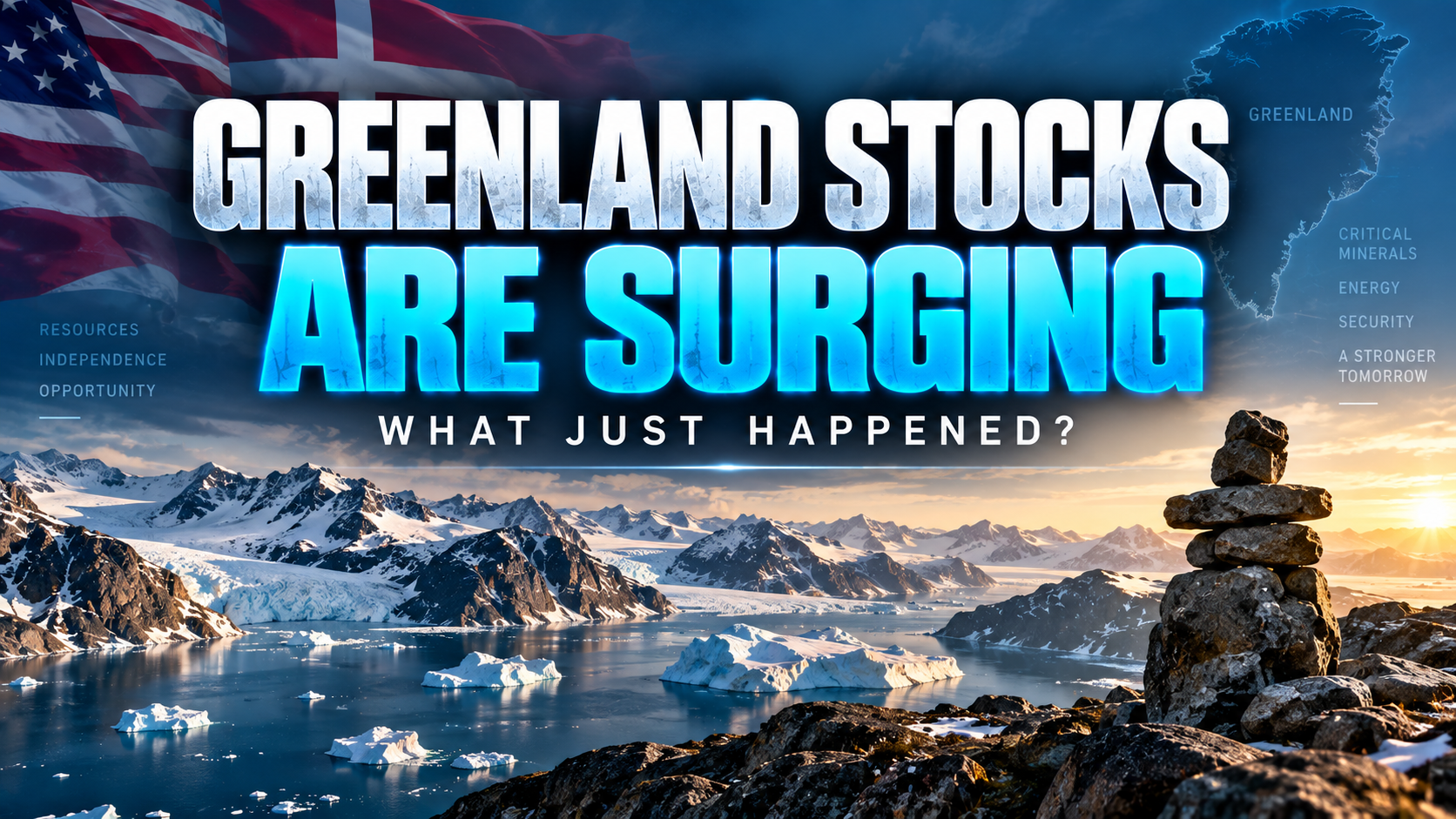
Something happened in Greenland over the weekend.
And Wall Street noticed.
Before the opening bell Monday morning, a small group of Greenland-linked stocks suddenly appeared near the top of the premarket leaderboards.
Greenland Energy Company (NASDAQ: GLND) was up roughly 149% in one early snapshot.
Greenland Mines Ltd. (NASDAQ: GRML) was up approximately 72%.
UPDATED SEPTEMBER 24, 2026: This article has been updated to include Greenland Mines’ latest financing, termination of its ATM facility and completion of the 2026 Sarfartoq field program.
Critical Metals Corp. (NASDAQ: CRML) was up around 32%.
Those numbers were changing quickly in premarket trading, but the direction wasn’t subtle. Greenland had suddenly become one of the hottest corners of the market.
So… what happened?
The immediate catalyst was news of a new security agreement involving the United States, Denmark and Greenland.
But that’s only part of the story.
Because underneath the geopolitical headlines sits something the United States and its allies have been thinking about for years:
What’s actually in the ground in Greenland?
Rare earths. Critical minerals. Precious metals. And potentially enormous energy resources.
For investors trying to figure out why Greenland stocks are moving—and which publicly traded companies actually have direct exposure to the island—here’s where things get interesting.
Why Are Greenland Stocks Rising Today?
The catalyst arrived Friday evening when President Donald Trump announced a new security framework involving the United States, Denmark and Greenland.
According to public reporting, the framework would expand the long-term U.S. security role in Greenland while restricting non-NATO adversaries from establishing military positions and limiting certain sensitive investments. Greenland remains under Danish sovereignty; the security arrangement does not amount to a U.S. acquisition of the territory.
That distinction matters.
So does another one:
A security agreement is not a mining agreement.
The announcement does not, by itself, award mining permits, finance mines, guarantee commodity purchases or create government contracts for the companies discussed below.
The market appears to be making a broader connection.
Greenland is strategically important.
Its natural resources are strategically important.
And increased U.S. attention toward the island is putting companies with actual Greenland assets under a much brighter spotlight.
Three Nasdaq-listed names have attracted particularly heavy attention.
The companies below are presented in no particular order.

1. Greenland Energy Company (NASDAQ: GLND)
Greenland Energy was the eye-popper Monday morning.
Shares surged more than 140% in premarket trading in some early snapshots following the security announcement.
But Greenland Energy isn’t a rare-earth company.
It’s an early-stage oil and gas exploration company focused on the Jameson Land Basin in East Greenland.
The company is targeting a potentially massive hydrocarbon system and plans to drill two wells in 2026. Under its project arrangements, Greenland Energy can earn up to a 70% working interest. Published company estimates have referenced potential resources of up to 13 billion barrels of oil.
Potential is the important word there.
This remains exploration—not proven commercial production—and resource estimates shouldn’t be confused with recoverable reserves or future revenue.
Still, it’s not difficult to understand why traders connected the dots Monday morning.
If Greenland becomes increasingly important to U.S. and NATO strategy, companies controlling exploration rights on the island suddenly become much easier to notice.
And GLND certainly got noticed.
2. Greenland Mines Ltd. (NASDAQ: GRML)
UPDATE — SEPTEMBER 24: GRML RAISES MORE THAN $42 MILLION AND TERMINATES ITS ATM
The Greenland story didn’t stop with Monday’s market reaction.
Before the opening bell Thursday, Greenland Mines Ltd. (NASDAQ: GRML) announced that it had raised more than $42 million from existing investors through a registered direct offering of common stock and pre-funded warrants, along with the exercise of previously issued private warrants.
The financing was completed at $12 per share, according to the company, and all pre-funded warrants issued in the registered direct offering have now been exercised.
But another part of the announcement may be just as important to investors following the story:
Greenland Mines has terminated its at-the-market offering facility.
The company says the new capital substantially addresses its planned funding requirements through its targeted 2027 milestones across its Greenland portfolio.
At the same time, GRML announced that it has completed its 2026 geological and structural field program at the Sarfartoq NdPr Rare Earth Project in southwest Greenland.
Over roughly three weeks, crews conducted geological and structural mapping, drone-supported outcrop surveys and systematic rock sampling across priority areas of the Sarfartoq Carbonatite Complex. The work included sampling newly identified carbonatite-dyke occurrences and was designed in part to improve targets for future drilling and resource-upgrade work.
There is an important distinction for investors: the new samples have not yet produced assay results. Greenland Mines says they are expected to be submitted to a Canadian laboratory for rare-earth-element analysis. So today’s announcement advances the exploration program, but it does not establish new grades or additional mineral resources from the latest fieldwork.
Sarfartoq’s existing ST1 Mineral Resource remains approximately 12.2 million tons grading 1.32% total rare earth oxides (TREO). The company has previously reported a high-case pre-tax NPV8 of approximately $2.05 billion for the project, but those figures are based on an Initial Assessment and assumptions about a future operation—not current production or guaranteed economics.
Four days after Greenland-linked stocks suddenly moved into the market spotlight, the GRML story has therefore gained another layer: new capital, the termination of the ATM facility and fresh fieldwork at Sarfartoq.
What happens next will depend on execution—including future drilling, technical work, permitting, exploration results and ultimately whether the company’s projects can advance toward commercial development.
ORIGINAL ARTICLE: Then there’s Greenland Mines.
And this one is a very different story.
Rather than hydrocarbons, GRML provides exposure to two mineral projects that intersect directly with the growing Western conversation around critical-mineral security.
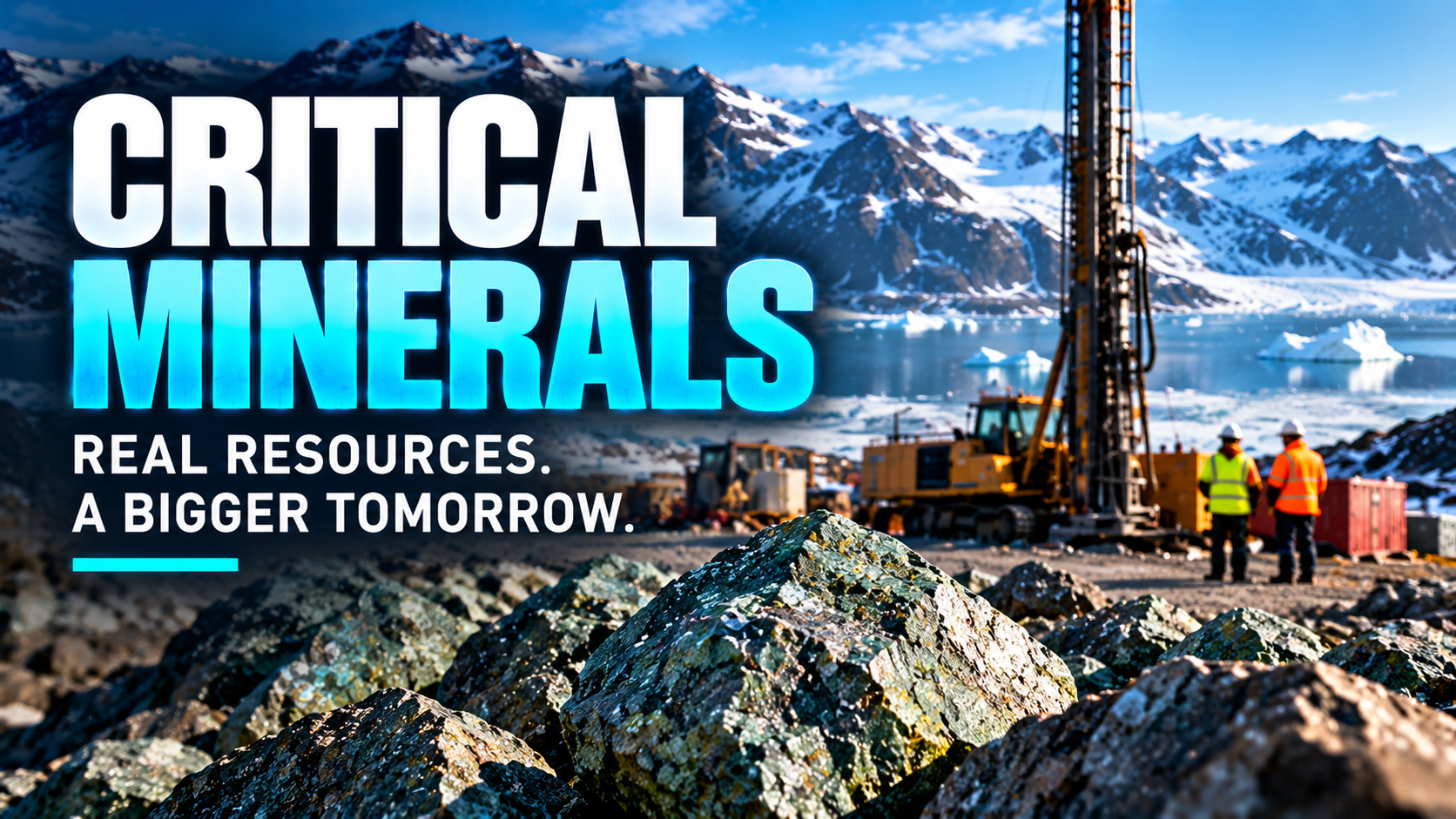
The first is Sarfartoq, a rare-earth project in West Greenland with significant neodymium-praseodymium, or NdPr, potential.
If you’ve never heard of NdPr, you’re not alone.
But you’ve probably used something containing it.
Neodymium and praseodymium are used in powerful permanent magnets found across electric motors, robotics, wind turbines, advanced electronics and defense applications.
Greenland Mines says Sarfartoq’s Initial Assessment contains a high-case pre-tax NPV of approximately $2.05 billion. The company also estimates that planned annual NdPr oxide production could equal approximately 34% of the amount currently refined outside China, measured against 2025 consumption levels. Those are company estimates based on assumptions about a future operation—not current production or guaranteed economics.
GRML’s second major Greenland asset is Skaergaard in East Greenland, a large undeveloped mineral system containing palladium, platinum and gold, with vanadium also part of the development story.
And these aren’t simply dormant claims sitting on a map.
On September 11, Greenland Mines reported completing a 104.8-ton bulk-sampling program at Skaergaard, while also advancing mapping and environmental baseline work at Sarfartoq. The company completed its acquisition of Sarfartoq on September 1.
Then came Friday’s geopolitical news.
Greenland Mines publicly welcomed the U.S.–Denmark–Greenland security framework and argued that it reinforces Greenland’s importance to Western critical-mineral supply chains.
The market reaction followed.
Again, though, there’s a line investors shouldn’t cross.
The new security framework does not mean the U.S. government has agreed to finance Sarfartoq or Skaergaard, buy GRML’s future production or guarantee either project’s development.
What changed is the geopolitical backdrop.
And right now, the market appears to be paying attention.
3. Critical Metals Corp. (NASDAQ: CRML)
If the phrase “Greenland rare earths” keeps appearing in your news feed, Critical Metals is another reason why.
CRML controls 92.5% of the Tanbreez project in southern Greenland, following Greenland government approval of the final ownership transfer earlier this year.
Tanbreez is a large heavy-rare-earth deposit containing the suite of eight heavy rare-earth elements highlighted by the company.
And unlike a story based entirely on geological potential, CRML already has an important commercial relationship attached to the project.
In May, Critical Metals announced a 15-year binding offtake agreement with REalloys involving rare-earth concentrate from Tanbreez.
That’s worth separating from Monday’s headlines.
The offtake agreement existed before the new security framework.
The security announcement didn’t create Tanbreez, CRML’s ownership position or the REalloys agreement.
What it did was put Greenland back on the front page.
CRML shares responded accordingly, rising roughly 25%-30% in early premarket snapshots Monday.
The Greenland Trade Is Already Spreading Beyond Greenland
Here’s where the story gets a little more interesting.
Monday’s reaction wasn’t completely confined to companies operating on the island.
Other U.S.-listed rare-earth companies also moved higher, including USA Rare Earth (NASDAQ: USAR) and MP Materials (NYSE: MP), which were reported up approximately 6% and 4%, respectively, in early trading.
Neither company owns the Greenland projects discussed above.
That’s an important distinction—but it also tells us something.
The market isn’t necessarily treating this as just a Greenland story.
It’s touching the much larger theme of Western critical-mineral independence.
China has long occupied a powerful position across portions of the global rare-earth supply chain. That has made alternative sources of rare earths and strategic minerals increasingly relevant to governments, defense contractors and manufacturers.
Greenland happens to sit at the intersection of several of those conversations at once:
Arctic security.
U.S.–European relations.
Rare earths.
Critical minerals.
Energy.
And supply chains.
Suddenly, an island most investors rarely thought about is producing multiple Nasdaq tickers showing up on the same premarket leaderboards.
Coincidence?
Maybe not.
But neither does that mean every Greenland project suddenly becomes economically viable—or every Greenland-related stock justifies whatever price the market assigns it during a volatile news-driven session.
That’s the part worth remembering after the opening bell.
So What Actually Changed?
Not the geology.
Sarfartoq was there last week.
So was Skaergaard.
Tanbreez didn’t suddenly appear over the weekend.
And the Jameson Land Basin didn’t magically acquire hydrocarbons Friday night.
What changed was attention.
The new U.S.–Denmark–Greenland security framework has pushed Greenland’s strategic importance back into the global conversation.
Markets are now asking what comes next.
Does increased Western strategic attention eventually translate into more infrastructure?
More investment?
Faster development of critical-mineral supply chains?
More government or private-sector partnerships?
Those are reasonable questions.
They are not yet answers.
For now, GLND, GRML and CRML provide three very different windows into the same increasingly important region—and Monday morning’s extraordinary price action shows just how quickly investors have begun looking through them.
Greenland Stocks FAQ
Why are Greenland stocks rising today?
Greenland-linked stocks moved sharply higher after the announcement of a new security framework involving the United States, Denmark and Greenland. Investors appear to be connecting increased U.S. strategic interest in Greenland with the island’s energy, rare-earth and critical-mineral resources.
Which publicly traded companies have direct exposure to Greenland?
Among the Nasdaq-listed companies receiving significant attention are Greenland Energy Company (NASDAQ: GLND), Greenland Mines Ltd. (NASDAQ: GRML) and Critical Metals Corp. (NASDAQ: CRML). Their Greenland exposure differs substantially: GLND is focused on oil and gas exploration, GRML controls the Sarfartoq and Skaergaard mineral projects, and CRML controls 92.5% of the Tanbreez rare-earth project.
What rare earth projects are in Greenland?
Two notable publicly traded-company projects are Greenland Mines’ Sarfartoq rare-earth project and Critical Metals’ Tanbreez heavy-rare-earth project. Greenland also contains numerous other mineral projects at varying stages of exploration and development.
Does the new security agreement give these companies U.S. government funding?
The security announcement itself should not be interpreted as funding, permitting, an offtake agreement or a government contract for GLND, GRML or CRML. Investors should evaluate company-specific agreements and government support separately from the broader geopolitical framework.
Why are rare earths important?
Rare-earth elements are used in technologies ranging from high-performance permanent magnets and electric motors to electronics and defense systems. Western governments and companies have increasingly focused on diversifying supply chains and reducing dependence on concentrated foreign processing capacity.
Disclosure
SmallCapExclusive received no compensation from any company discussed in this article for the preparation or publication of this specific article. SmallCapExclusive has, however, previously received compensation of up to $1,000,000 in connection with investor-awareness and marketing services relating to Greenland Mines Ltd. (NASDAQ: GRML) that has ended as of 9/10/26. That prior compensation creates a potential conflict of interest and should be considered when evaluating our coverage of GRML.
GRML Original Disclaimer
Small Cap Exclusive is owned and operated by King Tide Media, LLC, which is a U.S.-based corporation and has been compensated up to $1,000,000 by Greenland Mines Ltd for profiling Greenland Mines Ltd. (NASDAQ: GRML) beginning 3/23/2026.. We own ZERO shares of Greenland Mines Ltd. (NASDAQ: GRML).
This article is provided solely for informational and investor-awareness purposes and does not constitute investment advice, an offer to sell, or a solicitation of an offer to buy any security. SmallCapExclusive is not a registered broker-dealer or investment adviser.
Information contained herein has been obtained from publicly available sources believed to be reliable, but its accuracy or completeness is not guaranteed. References to resource estimates, project economics, potential production, exploration targets and future development are forward-looking and subject to significant risks and uncertainties. Exploration-stage and development-stage projects may never achieve commercial production.
Stock-price percentages referenced in this article reflect rapidly changing premarket trading on September 21, 2026 and may differ materially from subsequent prices. Small-cap and development-stage securities can be highly volatile and speculative. Readers should conduct their own due diligence, review the applicable companies’ SEC filings and other regulatory disclosures, and consult appropriate financial, legal or tax professionals before making investment decisions.