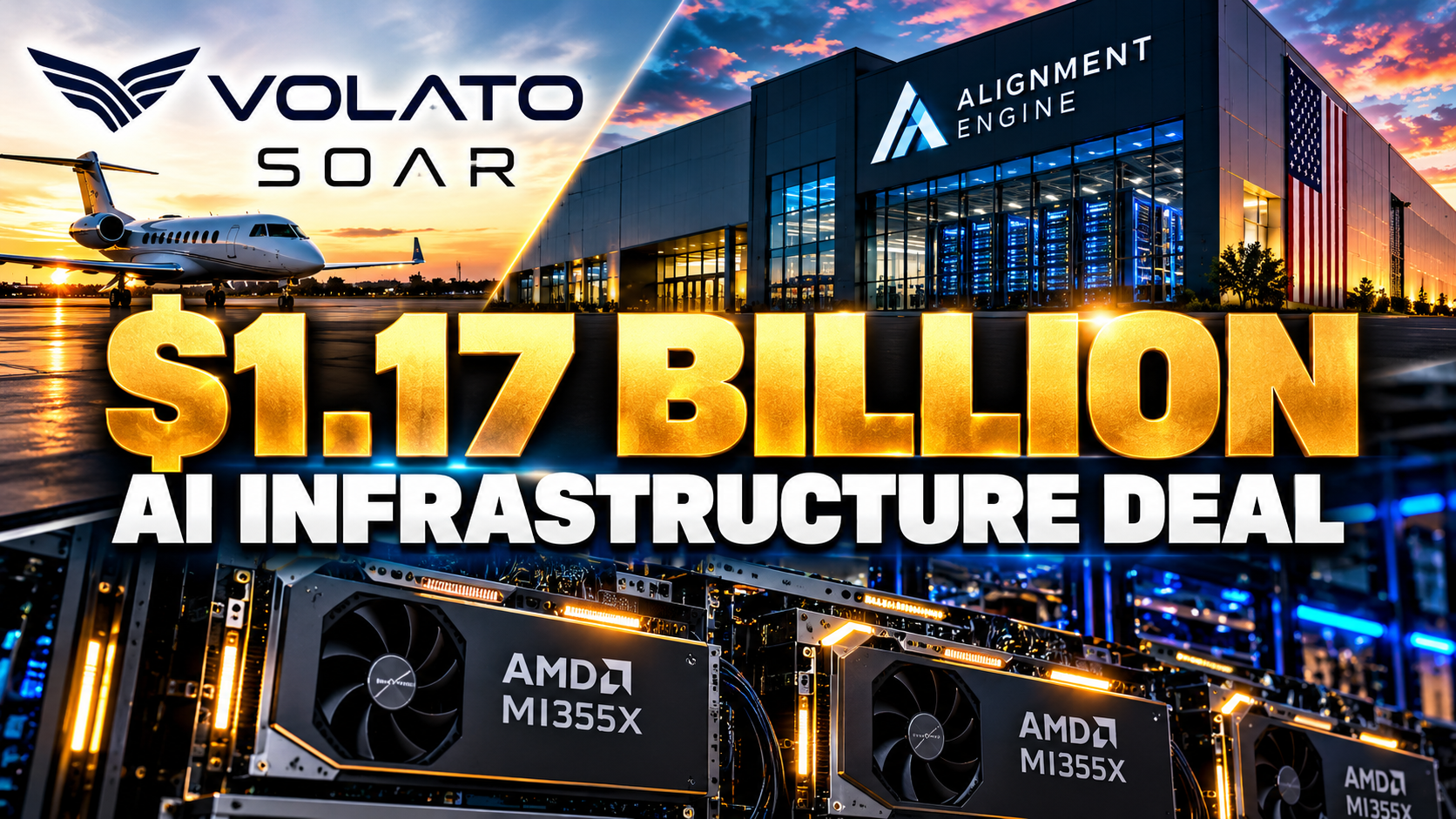
Volato Group (NYSE American: SOAR) caught the market’s attention after its Alignment Engine subsidiary disclosed approximately $1.17 billion in AI infrastructure orders. The headline is enormous, but the structure behind the agreements may be the more important part of the story.
The SOAR AI deal caught the market’s attention after Volato Group’s Alignment Engine subsidiary disclosed approximately $1.17 billion in aggregate contractual value from two AI infrastructure orders.
That’s an enormous headline for a company many investors still associate with private aviation.
But the numbers underneath the announcement may be even more interesting.
The agreements involve four-year dedicated AI infrastructure deployments, AMD GPUs and approximately $133 million in contractual prepayments.
And unlike plenty of AI announcements that never get much further than a press release, Volato disclosed the material agreement through an SEC filing.
So what exactly did SOAR sign—and what needs to happen next?
What Is the SOAR AI Deal?
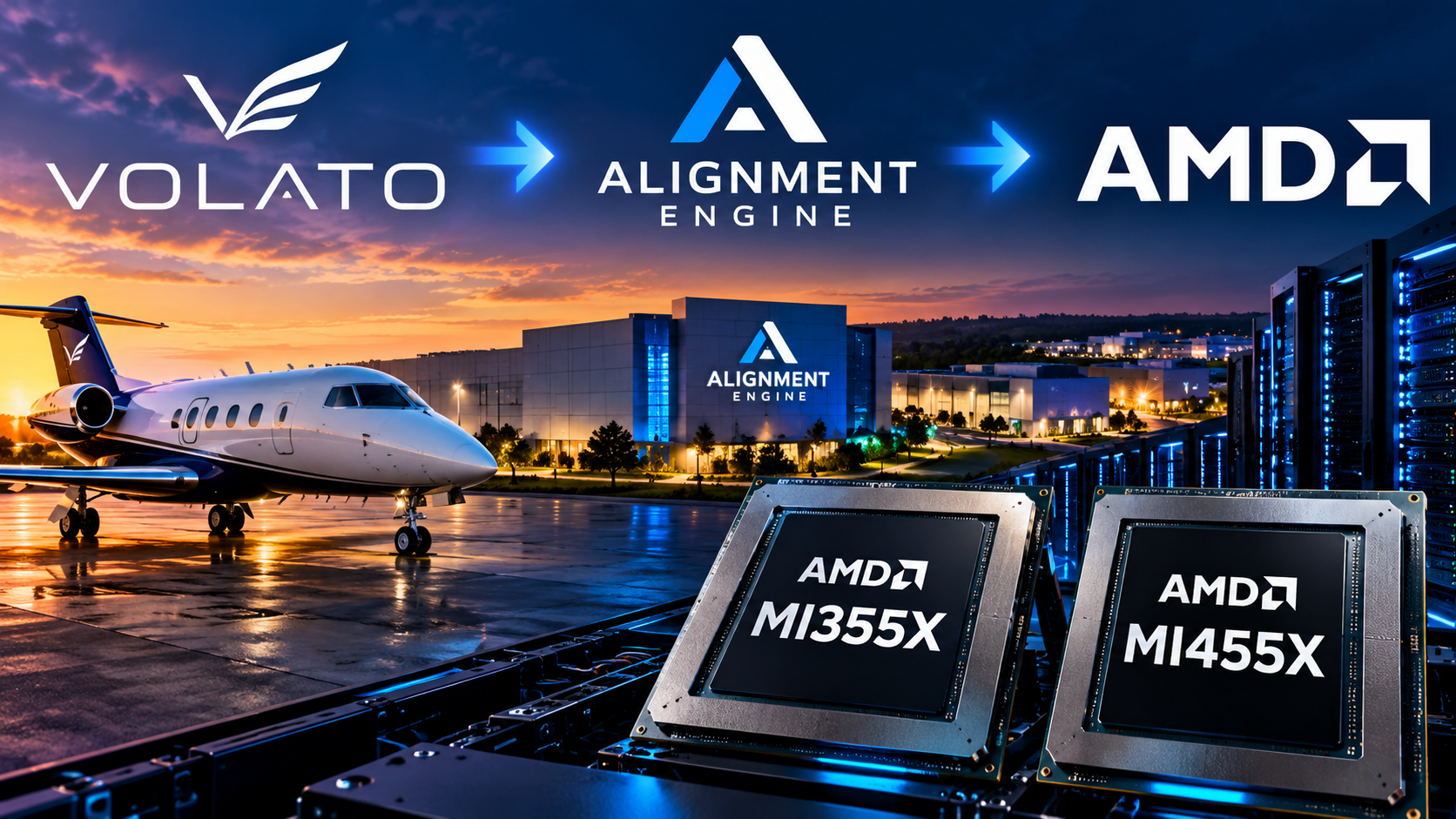
Alignment Engine entered into a Master Services Agreement with an unnamed customer, along with two initial orders representing approximately $1.17 billion in aggregate contractual value.
Both orders involve dedicated, single-tenant GPU clusters planned for Alignment Engine’s Ohio AI infrastructure campus.
The first deployment is expected to use AMD MI355X GPUs, with a contractual start date of December 31, 2026.
The second is expected to use AMD MI455X GPUs, with a contractual start date of June 30, 2027.
Each deployment carries a 48-month term.
Why the Four-Year Structure Matters
Alignment Engine isn’t describing a spot-market business where customers simply rent GPU capacity whenever additional computing power is needed.
The model is centered around dedicated infrastructure contracted over multiple years.
That could potentially give Alignment Engine greater visibility into customer demand before deploying substantial capital into additional infrastructure.
But the SOAR AI deal still requires significant execution before its full contractual value can translate into recognized revenue.
The $133 Million Prepayment Is an Important Detail
The $1.17 billion figure naturally dominates the headline.
But another number deserves attention:
Approximately $133 million.
That’s the amount Volato says the customer has committed in contractual prepayments.
Roughly $40 million is due following execution of the initial order, with additional prepayments scheduled according to specified dates and equipment-shipment milestones.
The remainder of the contract value is scheduled to be paid over the four-year terms on a take-or-pay basis, subject to the agreements.
Why Prepayments Could Matter
AI infrastructure can require enormous upfront expenditures.
GPUs have to be acquired. Data-center infrastructure has to be built or prepared. Power, networking and cooling all have to be available before compute capacity can be delivered.
Alignment Engine’s strategy is designed around securing longer-term customer commitments while using contractual prepayments to help support infrastructure deployment.
That’s potentially important.
But it doesn’t eliminate execution risk.
And it certainly doesn’t mean Volato suddenly has $1.17 billion sitting in the bank.
The SOAR AI Deal Is Not $1.17 Billion of Revenue Today
This may be the single most important distinction in the entire story.
Contract value is not current revenue.
The orders cover four-year deployments that haven’t begun yet.
The first contractual start date is December 31, 2026.
The second is June 30, 2027.
The agreements also contain delivery, acceptance, service-level and performance requirements. The Master Services Agreement includes termination provisions involving circumstances such as uncured material breaches and certain bankruptcy or insolvency events.
There is therefore a substantial amount of work between signing these orders and ultimately realizing their full economic value.
For investors examining the SOAR AI deal, that’s where attention should increasingly shift.
The announcement was step one.
Execution is step two.
How Did Volato Become an AI Infrastructure Company?
This may be the strangest part of the story for investors who remember Volato primarily as a private-aviation company.
Earlier this month, Volato completed its merger with Alignment Engine, moving the company directly into AI infrastructure.
Alignment Engine is developing a powered industrial campus in Ohio centered around high-density GPU computing, networking, power and cooling infrastructure.
The company says the site currently has approximately 154 MW of available power, with a roadmap toward approximately 480 MW.
Then, shortly after completing the merger, Alignment Engine announced the two major AI infrastructure orders.
That sequence helps explain why SOAR suddenly attracted so much attention.
Volato didn’t merely announce plans to enter AI infrastructure.
Its newly acquired subsidiary announced a customer agreement carrying more than $1 billion in aggregate contractual value.
Why AMD Is Part of the SOAR AI Deal
There’s another interesting component to the story:
AMD.
The first planned deployment calls for AMD’s MI355X accelerators, while the second is expected to use the company’s newer MI455X GPUs.
That’s notable in an AI infrastructure market where Nvidia has dominated much of the conversation.
A Broader AI Compute Market
Alignment Engine appears to be positioning around the idea that demand for AI computing infrastructure will increasingly extend across multiple hardware architectures.
Customers may evaluate infrastructure based on factors including performance, economics, workload requirements and availability.
If demand for non-Nvidia AI infrastructure continues expanding, dedicated AMD GPU capacity could give Alignment Engine a differentiated position.
But the hardware story ultimately comes back to the same issue as the broader agreement:
Can Alignment Engine deliver?
What Comes Next for the SOAR AI Deal?
After a dramatic market reaction, it’s easy to focus primarily on SOAR’s stock chart.
The more useful information over the coming months should come from the underlying business milestones.
One of the first things to watch is the contemplated approximately $40 million initial prepayment.
After that, attention should shift toward equipment procurement and construction.
Then comes the December 31 contractual start date for the MI355X deployment.
The second major milestone arrives next summer, when the MI455X deployment is scheduled to begin.
The Milestones Worth Watching
The questions are relatively straightforward.
Does Alignment Engine receive contractual payments as contemplated?
Does infrastructure development progress according to schedule?
Can the company procure and deploy the required AMD hardware?
Does the first cluster begin operating around its contractual start date?
Does the second deployment follow?
And can Alignment Engine meet the acceptance, performance and service requirements contained in its customer agreements?
Those milestones should provide considerably more information about the economic significance of the SOAR AI deal than the stock’s performance on any individual trading day.
The Bottom Line on the SOAR AI Deal
There’s an obvious reason this announcement captured attention.
A small publicly traded company that recently completed a transformative merger into AI infrastructure disclosed approximately $1.17 billion in aggregate contractual orders.
The presence of approximately $133 million in contractual prepayments makes the structure particularly noteworthy.
The planned use of AMD MI355X and MI455X GPUs adds another layer to the story as companies search for enormous amounts of computing capacity to support increasingly demanding AI workloads.
But none of that eliminates the risks between signing an agreement and successfully delivering the infrastructure behind it.
Alignment Engine now has contractual start dates, hardware requirements, infrastructure requirements and a large customer expecting dedicated AI compute capacity.
The headline has arrived.
Now the SOAR AI deal becomes an execution story.
Small Cap Exclusive is owned and operated by King Tide Media, LLC, which is a U.S.-based corporation and has not been compensated.