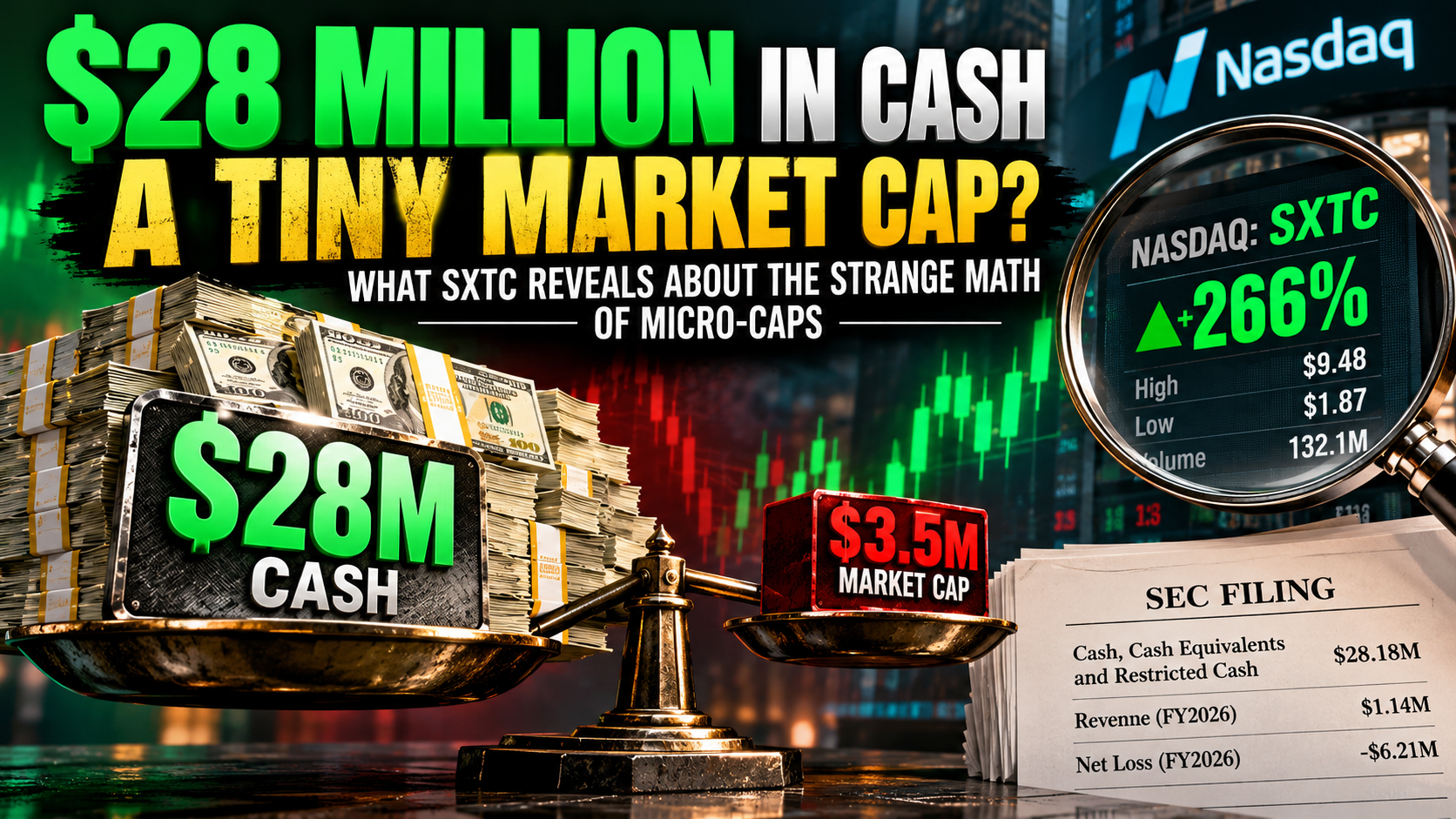
How can a public company report tens of millions of dollars in cash while the stock market values its equity at only a fraction of that amount?
That question became particularly interesting this week as China SXT Pharmaceuticals Inc. (NASDAQ: SXTC) erupted in extraordinary trading activity.
SXTC entered Wednesday after closing Tuesday at $1.25. During Wednesday’s session, trading volume exploded far beyond its recent norms as the stock experienced extreme intraday volatility.
But behind the price action sits an even stranger question. SXTC appears on financial screens as one of those unusual stocks trading below cash value.
According to China SXT’s March 31, 2026 annual filing, the company reported approximately $28.18 million in cash, cash equivalents and restricted cash.
Meanwhile, third-party market data recently placed SXTC’s market capitalization in the single-digit millions.
At first glance, that math seems almost impossible.
But cash greater than market cap isn’t necessarily a stock-market cheat code. In micro-caps, it can be an invitation to look much deeper.
How Can Cash Be Greater Than Market Cap?
Market capitalization represents the market value investors currently assign to a company’s outstanding equity. A balance sheet is different: it’s a snapshot of the company’s financial position at a specific point in time.
That’s an important distinction when looking for stocks trading below cash value.
SXTC’s reported $28.18 million figure, for example, includes restricted cash. Restricted cash may be subject to limitations on how it can be used, meaning investors shouldn’t automatically treat the entire figure as freely available money.
There’s also the question of what happens to the cash over time.
China SXT’s fiscal 2026 annual report showed approximately $1.14 million in revenue and a $6.2 million loss from operations.
For investors researching companies with cash greater than market cap, that’s critical.
A cash balance can provide financial runway. But if the underlying business is consuming capital, today’s balance-sheet snapshot may look very different in the future.
SXTC’s Capital Structure Changes the Picture
The SXTC story becomes even more unusual when investors move beyond the balance sheet.
China SXT has repeatedly consolidated its shares, including a 1-for-8 consolidation in February 2025, a 1-for-150 consolidation in February 2026 and a 1-for-80 consolidation in August 2026.
That last consolidation reduced approximately 105.7 million Class A shares to roughly 1.32 million shares.
This is where having a reverse stock split explained becomes essential.
A reverse stock split combines existing shares into fewer shares. In a 1-for-80 consolidation, 80 old shares become one new share.
The transaction itself doesn’t create additional corporate value.
But a reverse stock split can dramatically change the numbers investors see. The number of shares outstanding falls, the per-share price adjusts and historical price data is typically adjusted to reflect the consolidation.
For a micro-cap company, that can also leave an unusually compressed share structure.
Financing and Dilution Matter Too
There’s another reason investors shouldn’t assume stocks trading below cash value are automatically undervalued: the cash has to come from somewhere.
SXTC has raised capital through equity financing.
In July 2026, the company announced a $9 million registered direct offering involving 4.5 million units at $2.00 per unit. The financing also involved warrants, adding another layer to the company’s capital structure.
That distinction matters.
A company can raise cash and strengthen its balance sheet while simultaneously issuing securities that dilute existing shareholders or create the possibility of future dilution.
So cash greater than market cap can sometimes tell investors as much about a company’s financing history as it does about the value of its operating business.
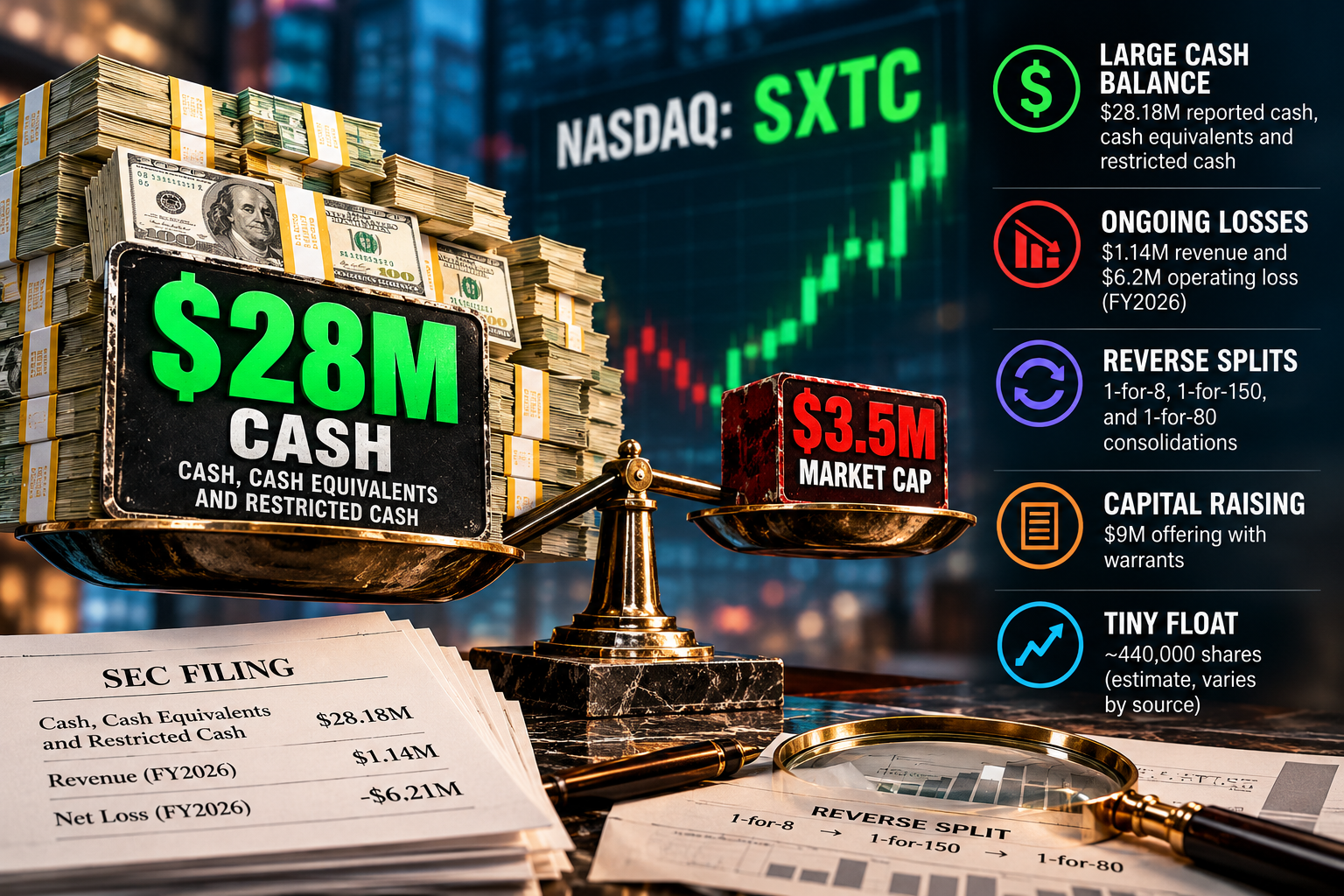
SXTC illustrates why stocks trading below cash value require a closer look at restricted cash, losses, reverse splits and potential dilution.
When a Tiny Share Structure Meets Massive Volume
Now Wednesday’s extraordinary SXTC trading becomes much more interesting.
Following the August consolidation, SXTC had a dramatically smaller reported share count. Third-party market data has also estimated an extremely small public float, although float estimates can vary and should not be treated as definitive.
Then enormous trading volume suddenly arrived.
That’s a potentially explosive combination.
When a relatively small effective trading supply encounters an enormous increase in buying and selling activity, price movements can become extreme.
That doesn’t guarantee a stock will rise.
It means volatility can become violent in either direction.
And it helps explain why understanding the mechanics behind a micro-cap can matter just as much as reading its income statement.
The Real Lesson From Stocks Trading Below Cash Value
SXTC didn’t suddenly discover millions of dollars Wednesday.
The more interesting story is the disconnect between its reported financial position, operating performance, financing history, post-consolidation share structure and the market value investors assign to the company.
That’s why stocks trading below cash value deserve deeper analysis rather than a simple screen.
Investors need to ask: How much cash is unrestricted? How quickly is the company consuming it? How was that cash raised? What warrants or other potentially dilutive securities exist? And how have reverse stock splits changed the share structure?
Finding cash greater than market cap can uncover a fascinating anomaly.
It doesn’t automatically uncover a bargain.
SXTC provides an unusually vivid example of why.
In micro-caps, the balance sheet tells you what the company reports owning. The capital structure helps explain what each share may actually represent.
Disclosure: SmallCapExclusive has not been compensated by China SXT Pharmaceuticals, Inc. (NASDAQ: SXTC), its affiliates, or any third party for the preparation or publication of this article. This content is provided for informational and educational purposes only and does not constitute investment advice or a recommendation to buy or sell any security. Small-cap and micro-cap securities can be highly volatile and involve substantial risk. Readers should conduct their own due diligence and consult a qualified financial professional before making investment decisions.FULL DISCLAIMER