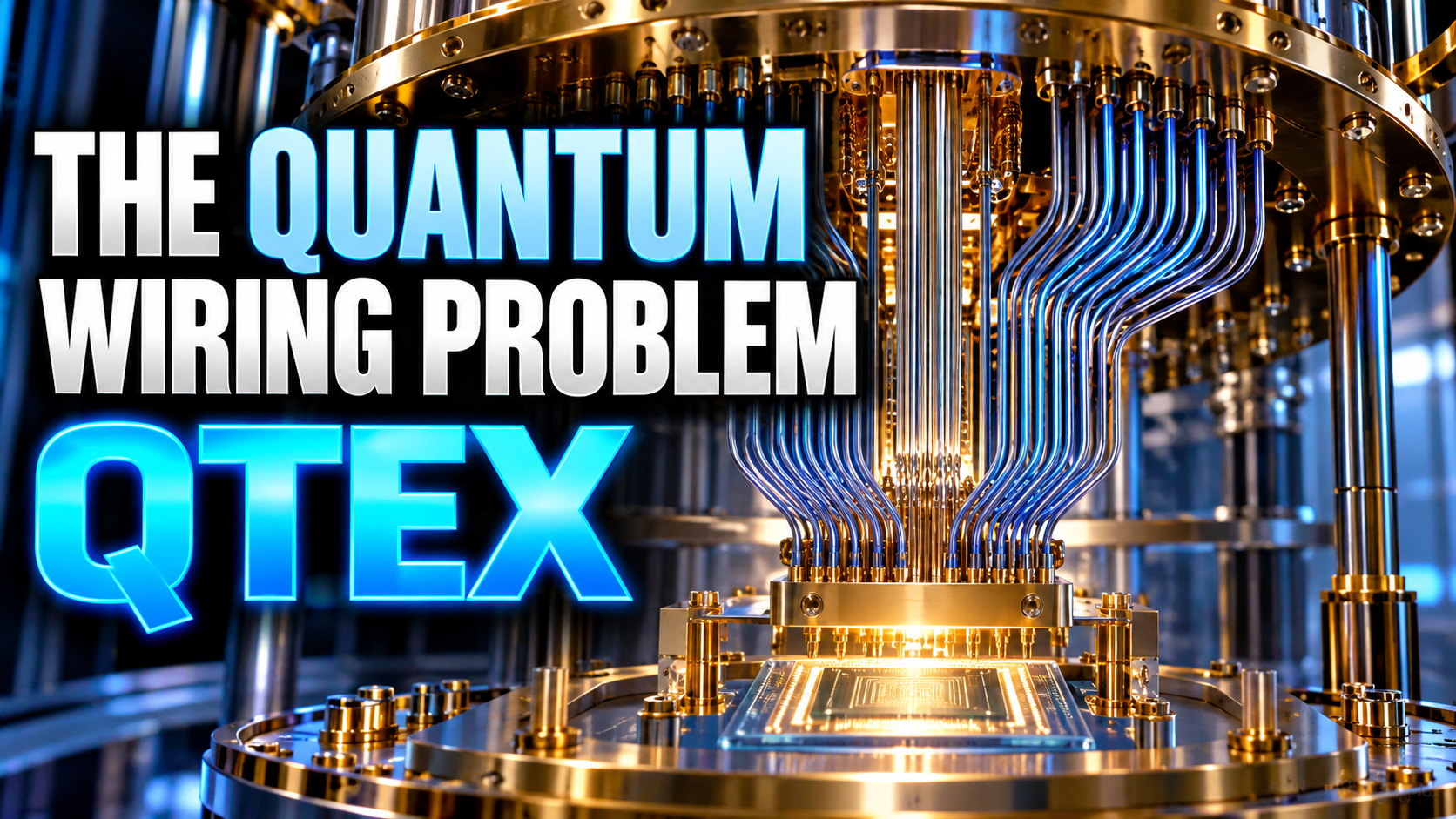
Quantum computing has a wiring problem that gets considerably harder as machines get larger. QTREX Quantum just put its cryogenic interconnect through independent testing at 20 millikelvin, reporting more than 100 dB of channel isolation across the 4–8 GHz qubit band. Now the company that performed the testing and QTREX are finalizing a definitive agreement.
Most conversations about quantum computing eventually come back to the same thing.
Qubits.
How many can a machine support? How stable are they? How long can they maintain their quantum state? And, eventually, how do you build enough of them to create a genuinely useful quantum computer?
But there’s a less glamorous engineering problem sitting underneath all of that.
You have to connect them.
Superconducting quantum processors operate at temperatures approaching absolute zero, while much of the electronics used to control and read them sit outside that environment. Microwave signals therefore have to travel through a cryogenic system to reach the processor.
With today’s machines, that’s manageable.
Start talking about quantum computers with tens or hundreds of thousands of connections, however, and wiring itself becomes part of the scaling problem.
That’s the problem QTREX Quantum Ltd. (NASDAQ: QTEX) is trying to solve.
And on October 1, the company announced an important test of whether its approach actually works under the extreme conditions found inside a quantum computer.
The QTREX Quantum Interconnect Was Tested at 20 Millikelvin
This wasn’t QTREX testing its own technology and publishing the result.
According to the company’s announcement, one of the quantum computing industry’s leading companies evaluated the QTREX quantum interconnect inside its own cryogenic system using its own instruments, reference cables and calibration standards.
The test reached 20 millikelvin.
That’s 0.02 degrees above absolute zero and right in the territory where superconducting quantum processors operate.
The reported result that jumps off the page is channel-to-channel isolation.
QTREX reported isolation exceeding 100 dB across the 4–8 GHz qubit band between adjacent channels separated by just 0.34 millimeters over a 15-centimeter run.
According to the company, no crosstalk was detected above the measurement equipment’s noise floor across any of the tested channel pairs.
QTREX compares that performance with a published 40 dB channel-to-channel crosstalk specification for leading flexible cryogenic cabling.
That’s more than a 60 dB difference.
It doesn’t mean QTREX has suddenly proven it can replace conventional cryogenic cabling throughout the quantum industry. A commercial quantum system involves considerably more than one performance measurement.
What it does show is that the technology operated in the environment it was designed for — and it did so in somebody else’s equipment.
That makes this test much more interesting.
Why Crosstalk Matters in Quantum Computing
Imagine trying to run thousands of extremely sensitive microwave signals beside one another.
Now pack those signal paths increasingly close together.
The signals still need to reach the correct destination without interfering with the channel sitting beside them.
That’s essentially the problem.
Quantum processors are extraordinarily sensitive systems. As engineers try to increase connection density, maintaining isolation between channels becomes increasingly important.
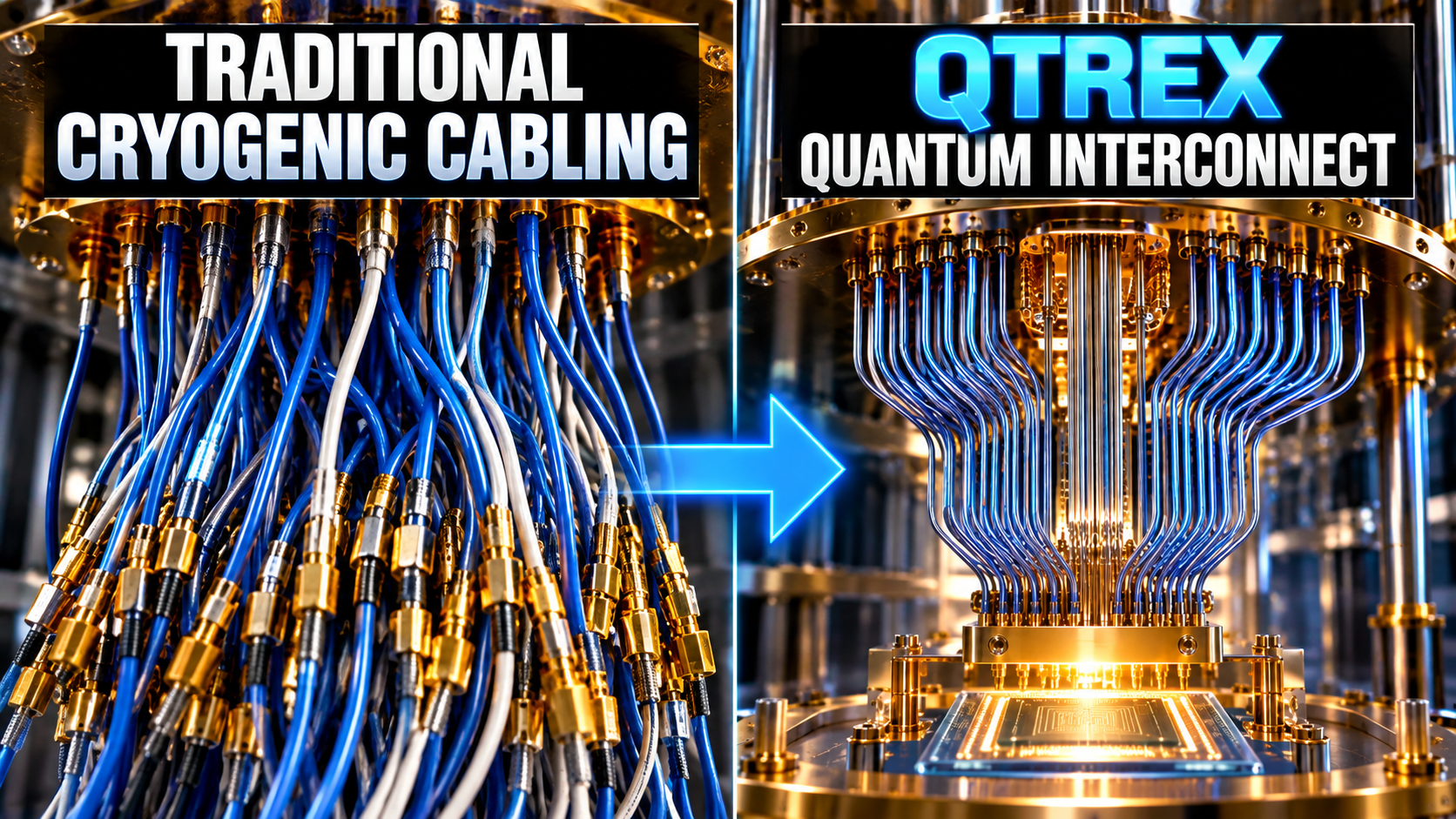
QTREX’s approach is unusual because it uses Additively Manufactured Electronics, or AME, to manufacture multiple shielded signal pathways as an integrated structure.
Instead of routing thousands of conventional individual coaxial cables through the system, QTREX is attempting to manufacture the connectivity itself.
Its architecture places fully shielded channels approximately one-third of a millimeter apart, approaching 30 channels per centimeter of width.
Adjacent channels can share shield walls.
That matters for more than space.
The Other Problem Is Heat
Metal carries electrical signals extremely well.
Unfortunately, it also carries heat.
That’s not particularly important inside your laptop.
Inside a dilution refrigerator trying to maintain temperatures measured in thousandths of a degree above absolute zero, it matters a lot.
Every physical connection running from warmer portions of a quantum system toward the processor potentially adds thermal load.
As the number of connections increases, that becomes another scaling problem.
QTREX says the thin shared-wall architecture used in its interconnect can reduce the amount of metal required and estimates that its design conducts roughly half the heat of an equivalent coaxial-cable configuration into the cooling stages.
That’s an important part of the thesis.
The company isn’t simply trying to squeeze more wires into the same space.
It’s trying to increase connection density while simultaneously addressing signal isolation, thermal load and assembly complexity.
Whether those advantages hold as systems become dramatically larger remains to be demonstrated.
But the October test provides another useful piece of evidence.
The Test Went Beyond One Measurement
The >100 dB isolation number will probably receive most of the attention, but the rest of the testing matters too.
QTREX reported that the channels remained phase matched at 20 millikelvin.
Insertion loss was approximately 1 dB at 1 GHz and 2 dB at 6 GHz, including connectors, while impedance remained consistent along the line.
Then the system was warmed back to room temperature and cooled again.
According to QTREX, performance during the second cooldown remained unchanged.
The company also reported unchanged RF performance following significant bending and vacuum exposure, while X-ray and optical inspection found no cracks, delamination or subsurface defects.
Those are exactly the kinds of things that matter if an experimental interconnect is eventually going to become a manufactured component.
A cable that performs beautifully once isn’t particularly useful if it can’t survive installation, temperature cycling and normal handling.
QTREX Has Been Designing for Much Larger Quantum Systems
The October announcement makes more sense when viewed beside another QTREX announcement from August.
The company unveiled an ultra-high-density cryogenic interconnect architecture designed to support as many as 17,280 coaxial lines per cryogenic stage in a full-scale configuration.
That does not mean QTREX currently has 17,280 connections operating inside a commercial quantum computer.
It’s a designed system capacity.
But it shows what the company is actually aiming at.
QTREX isn’t trying to make a slightly smaller microwave cable.
It’s trying to rethink how thousands of microwave connections can physically move through a cryogenic quantum system.
That becomes more relevant as the industry talks about moving beyond today’s relatively modest qubit counts.
Eventually, simply adding another conventional cable for every required connection becomes difficult.
Space matters.
Heat matters.
Installation matters.
Reliability matters.
And the economics of assembling thousands upon thousands of individual components matter.
Additive manufacturing offers a different way of approaching that problem.
The October test suggests the basic architecture can preserve the microwave characteristics required close to the quantum processor.
Now comes the commercial part.
A Definitive Agreement Could Be the Next QTEX Catalyst
QTREX quantum interconnect tested for cryogenic quantum computing
This is the part of the October announcement we’ll be watching most closely.
QTREX says the quantum computing company that conducted the independent testing is now working with QTREX to finalize a binding definitive agreement.
The company hasn’t been identified yet.
QTREX says it expects to disclose the counterparty’s identity, its field of activity and details of the agreement within weeks.
There are two important distinctions here.
The testing has happened.
The definitive agreement has not yet been announced as completed.
Until it is signed and disclosed, investors shouldn’t treat it as a completed commercial transaction.
But the sequence itself is interesting.
A quantum company established performance requirements.
QTREX built the interconnect.
The customer tested it independently inside its own cryogenic system.
The technology reached 20 millikelvin.
The reported performance met the test conditions.
And now the parties are working toward an agreement.
That’s a much more tangible progression than simply announcing that two companies intend to explore quantum technology together.
QTREX has also said it expects to announce agreements with several additional quantum-computing companies during the fourth quarter.
Again, those are expectations.
We’ll find out whether they become contracts.
There Is Already a Business Underneath the Quantum Story
QTREX’s quantum ambitions are still early, but its additive-manufacturing operation is already generating revenue.
The company acquired its AME platform in April 2026.
For the first half of the year, QTREX reported approximately $1.55 million in revenue, compared with $289,000 during the first half of 2025.
That’s roughly 438% year-over-year growth, although that percentage needs context.
All of the 2026 revenue came from the newly acquired AME and Quantum segment during only 86 days under QTREX ownership, so this isn’t a clean apples-to-apples picture of organic growth inside the same business.
The revenue composition is still useful.
Approximately $1.24 million came from products and another $313,000 from services.
QTREX reported consolidated gross margin of approximately 61%.
The company also reported approximately $10.7 million in cash, cash equivalents and deposits as of June 30.
That gives the quantum story an operating business underneath it rather than leaving investors with nothing but a technology roadmap.
And AME isn’t limited to quantum computing.
QTREX Is Taking AME Into Defense and Advanced Electronics
The same ability to manufacture complex electronics in three dimensions has potential applications anywhere size, weight, geometry and performance become difficult constraints.
That includes defense and aerospace.
In June, QTREX announced that one of the largest U.S.-based interconnect manufacturers had moved its AME system from development onto the production floor following a validation program that the company said achieved a 97% yield across hundreds of evaluations.
QTREX has also announced a purchase order from a U.S.-based Fortune 500 multinational for an AME system and related materials.
Then in September, the company announced immediate deployment of its AME technology by one of Israel’s three largest defense companies.
That diversification could matter.
Quantum computing may be the part of the story attracting the most attention today, but commercial quantum systems are still developing.
Defense, aerospace and advanced electronics give QTREX other potential markets for the manufacturing platform while the quantum opportunity evolves.
QTEX Still Comes With Real Risks
Interesting technology doesn’t eliminate financial risk.
QTREX’s interim financial statements included disclosure concerning substantial doubt about the company’s ability to continue as a going concern.
The company has generated recurring operating losses and negative operating cash flow and expects to continue relying partly on external financing.
In August, QTREX completed a registered direct offering involving 11,111,111 ordinary shares at $0.90 per share, generating approximately $10 million in gross proceeds before expenses.
Additional equity financing could dilute existing shareholders.
There is also plenty left to prove technologically.
Independent performance at 20 millikelvin is important.
Mass production is different.
Integrating the technology into increasingly large quantum systems is different again.
And even if QTREX’s interconnect performs exactly as intended, the quantum industry is evolving quickly enough that architectures and connectivity requirements can change.
Those are meaningful risks.
They also give us a pretty straightforward set of milestones to follow.
What Happens Next for the QTREX Quantum Interconnect?
The next announcement could tell us considerably more than another laboratory test.
Who is the quantum company?
What exactly is covered by the definitive agreement?
Does it include additional development?
Production?
Integration?
Purchase commitments?
And does any of it begin producing meaningful revenue?
Those details will determine how important this October test ultimately becomes.
After that, we’d watch the additional quantum agreements QTREX says it expects during the fourth quarter and whether the company’s AME revenue continues developing.
The larger technology question is fascinating because it comes down to something surprisingly physical.
The quantum industry wants larger machines.
Larger machines require more connections.
Those connections have to carry extraordinarily precise signals into an extraordinarily cold environment without creating unacceptable interference, heat or complexity.
QTREX believes those connections can be manufactured differently.
Now we have evidence that its approach has been independently tested at 20 millikelvin, with the company reporting more than 100 dB of channel isolation across the relevant 4–8 GHz band.
That’s worth paying attention to.
But the announcement we’re waiting for now isn’t another test result.
It’s the agreement that comes after it.
Featured Image Alt:
QTREX quantum interconnect tested for cryogenic quantum computing
Featured Image Title:
QTREX Quantum Interconnect – 20 Millikelvin Quantum Computing Test
Secondary Phrases:
QTREX Quantum, QTEX, QTEX stock, quantum computing infrastructure, cryogenic interconnect, quantum computing wiring, AME technology, Additively Manufactured Electronics, 20 millikelvin quantum computing, quantum computing connectivity
IMAGE PLAN
Featured Image: Futuristic cryogenic quantum-computer interior with dense signal pathways converging on a quantum processor. Mobile-first, dramatic, clean. Large text only: THE QUANTUM WIRING PROBLEM and QTEX. No small subheadline.
Body Image 1: Conventional bundles of individual cryogenic coaxial cables contrasted visually with a compact integrated QTREX-style interconnect. Keep copy extremely limited.
Body Image 2: A visual descent through a dilution refrigerator toward the processor: ROOM TEMP → 4 K → 20 mK → QUBIT. Large labels only.
Body Image 3: Commercial progression graphic: BUILD → TEST → 20 mK → AGREEMENT? The question mark is important because the definitive agreement has not yet been disclosed.
Small Cap Exclusive has not received compensation from the company or any third party for the preparation or publication of this article. This is independent editorial content provided for informational purposes only and is not investment advice or a recommendation to buy or sell any security.